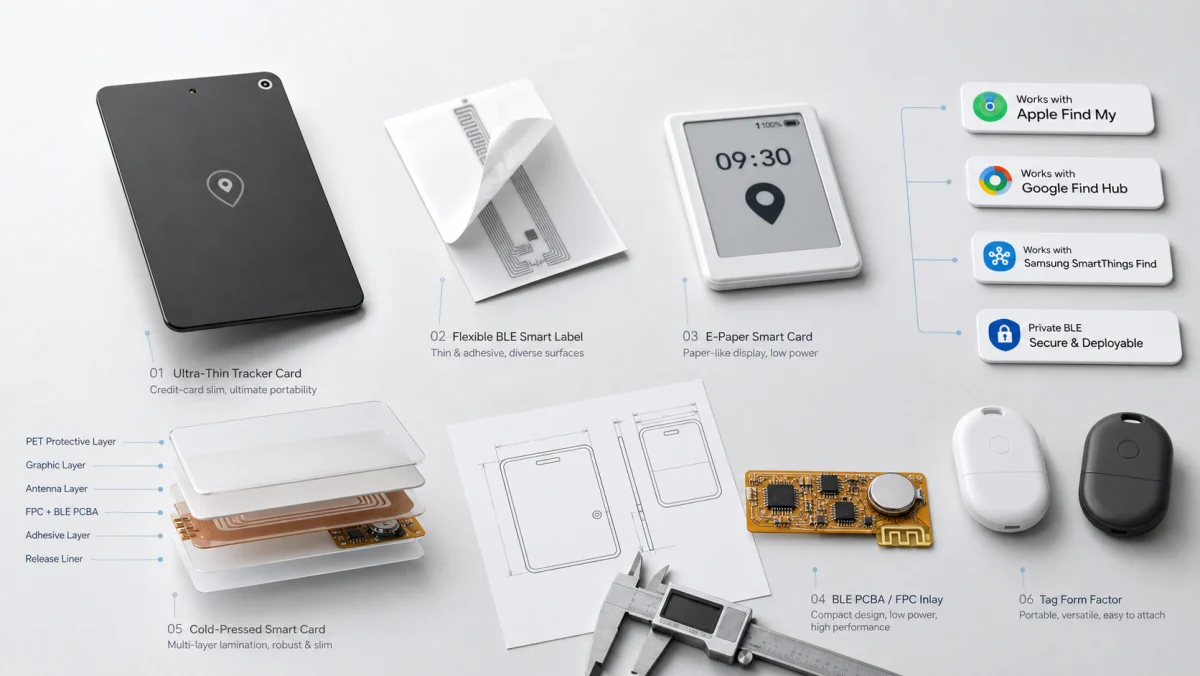
A cold-chain temperature logger records conditions from packing through delivery. A card-format logger puts that function in a slim enclosure that fits insulated shipping packs, reusable totes and equipment cases. Its design has to account for sensor response, battery performance at low temperatures and wireless readout through the finished packaging.
Yuli manufactures custom BLE and NFC temperature logger cards for brands through its cold-pressed smart card manufacturing service. We work with customer-supplied PCBAs or manufacture to an approved design, handling battery integration, programming, card printing, encapsulation and final testing. Your team retains ownership of the product design, brand and monitoring service.
Cold-chain and industrial applications
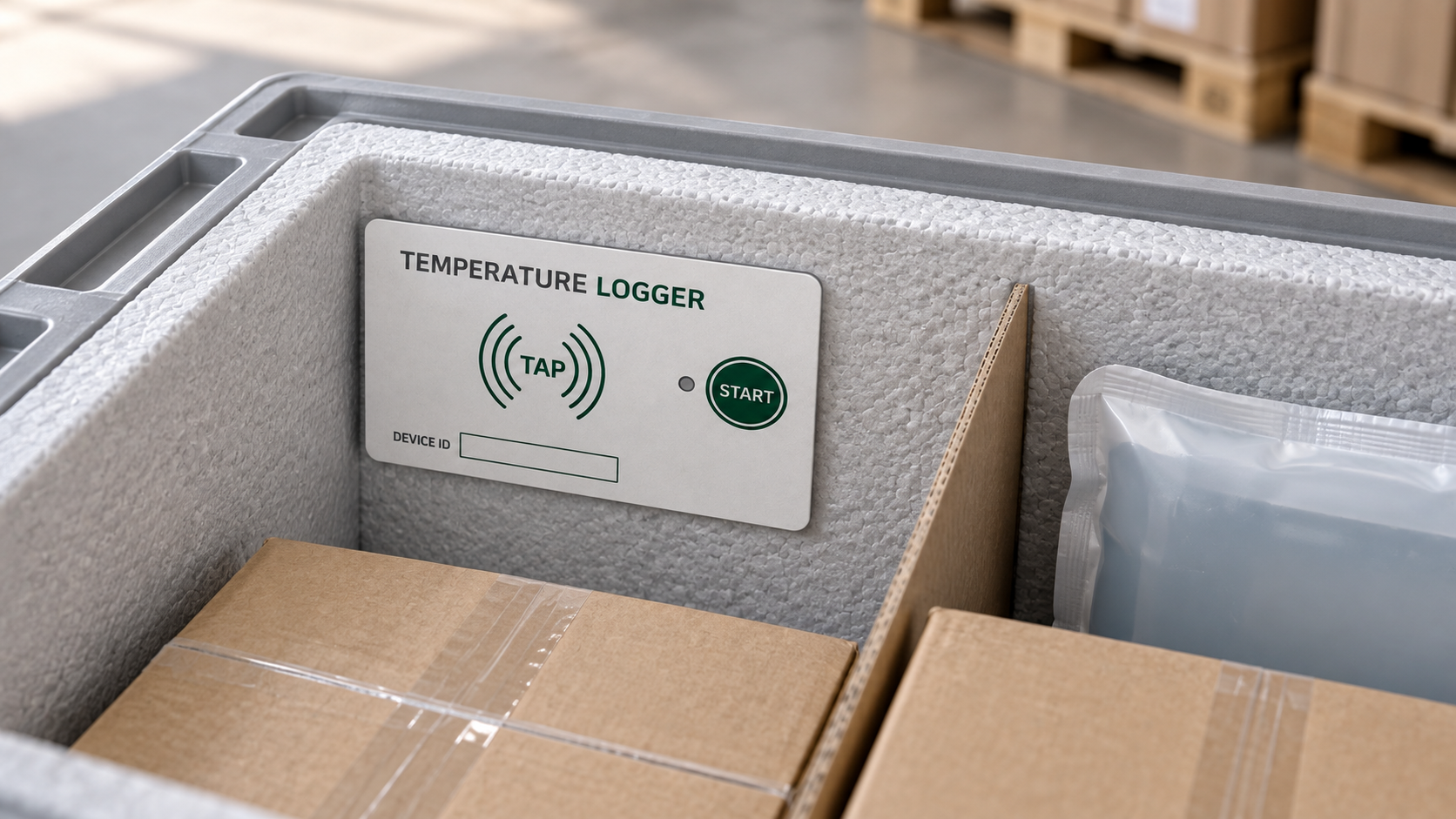
A thin logger card fits into a shallow holder, travels with a small shipment or stays attached to a returnable container. Its flat surface provides space for device identification and operating instructions. Staff can identify and read the device without handling a bulky instrument.
In cold-chain temperature monitoring, placement determines what the record means. A card inside a shipping pack measures conditions at its installed location, not the core temperature of the goods. A card outside the pack records a different environment. Installation instructions need to identify the measurement point and its position relative to the payload, carton wall and coolant packs.
For industrial monitoring, logger cards record storage conditions in parts containers or environmental exposure during equipment transport. Surface-temperature measurement is a different task: a card attached to a metal housing needs appropriate thermal contact with that surface. The same outline does not make these sensing arrangements interchangeable.
| Application | Monitoring requirement | Design requirements |
|---|---|---|
| Insulated shipment packaging | Conditions at a defined position throughout a journey | Secure placement, sufficient recording duration and dependable readout at receipt |
| Reusable cold-chain totes | Exposure across successive trips | Clear start/reset behavior, durable identification and a cleaning procedure compatible with the enclosure |
| Moisture-sensitive materials | Temperature and relative humidity during storage or transit | A humidity-sensing opening, suitable contamination protection and packaging-specific validation |
| Industrial tools and equipment cases | Environmental exposure during storage and transport | Mounting, handling durability and a way to retrieve records after periods without connectivity |
Card format suits shipment and storage monitoring. Hazardous areas, extreme temperatures or direct process measurement may require a different enclosure or an external probe.
Choosing between logger cards and monitoring labels
Thin temperature data loggers come in card and adhesive-label formats. A card fits a holder and is easy to retrieve. An adhesive temperature monitoring label stays on the chosen packaging surface. Selection depends on how staff install, activate and collect the device.
| Format | Handling during shipment | Main manufacturing considerations |
|---|---|---|
| Flat logger card | Inserted into a sleeve or retained at a defined location inside the pack | Card flatness, assembly height, readable controls and access for data collection |
| Adhesive electronic logger label | Attached to a selected packaging surface | Adhesive performance on that surface, bending limits and protection of the battery and connections |
| Reusable monitoring card | Removed, read and prepared for the next trip | Handling durability, cleaning compatibility, remaining battery life and separation of trip records |
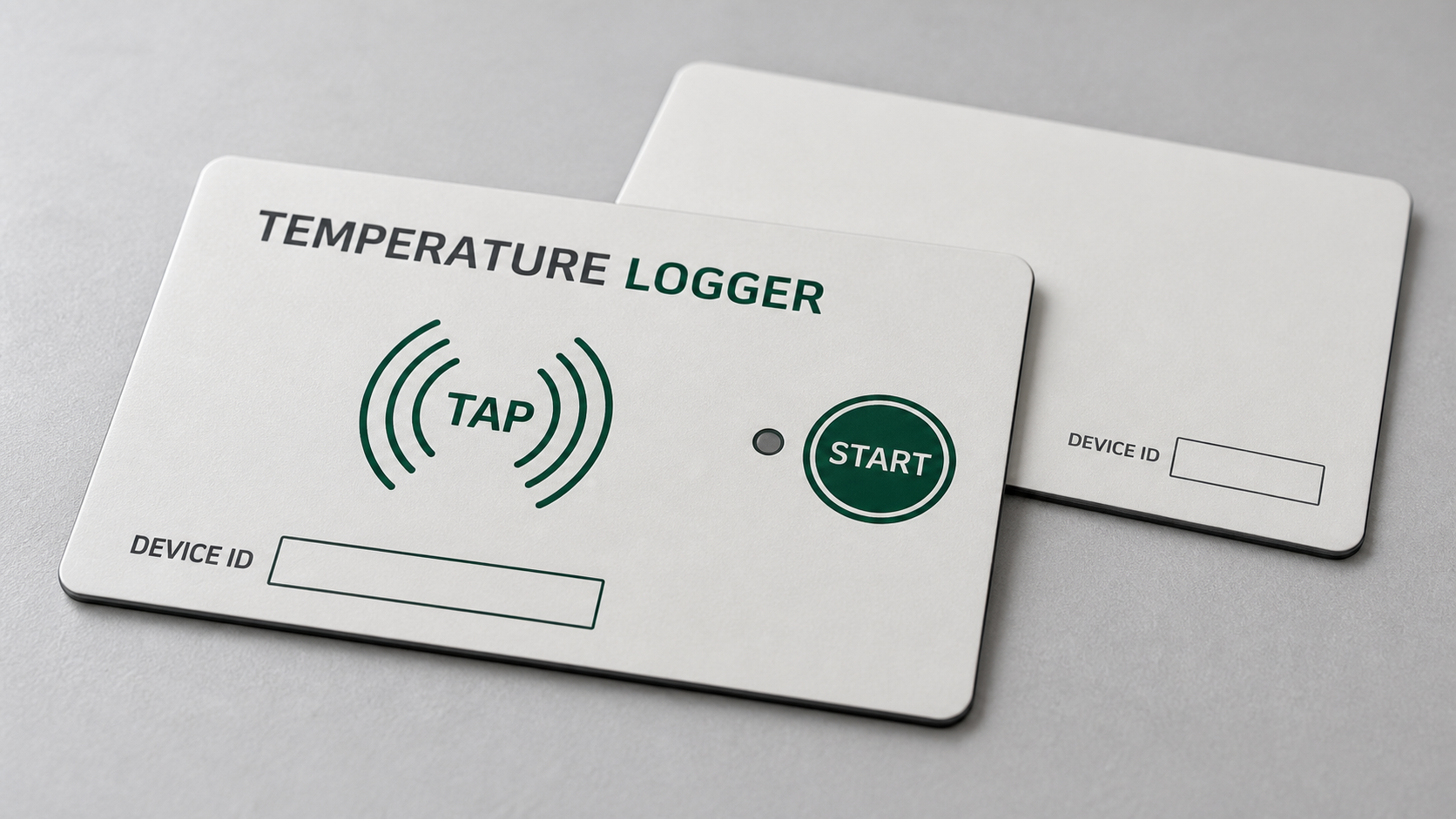
Controls and device identification
A display-free card uses a start button and status light to confirm activation. A marked NFC area shows receiving staff where to hold a compatible phone or reader. The indicator behavior and readout software must match the operating procedure, so staff can distinguish a recording device from one still awaiting activation.
The printed device ID links the card to its electronic identity and shipment record. Production checks must verify that these match. A mismatch can assign valid temperature data to the wrong carton, particularly when identical packages arrive together or a logger is reused.
Single-use and reusable loggers
A single-use temperature logger records one journey. Its battery must cover both shelf life before dispatch and the full recording period. A reusable temperature logger needs a defined end-of-trip procedure, protection against accidental erasure and enough remaining battery capacity for its next assignment. Enclosure sealing, rechargeability and reuse are separate design decisions.
A temperature indicator label shows whether an exposure threshold has been crossed. An electronic data logger stores measurements over time. Timestamped records are needed to establish when a temperature excursion occurred and how long it lasted; a color-change indicator alone cannot provide that history.
Cold-press manufacturing for custom temperature logger cards
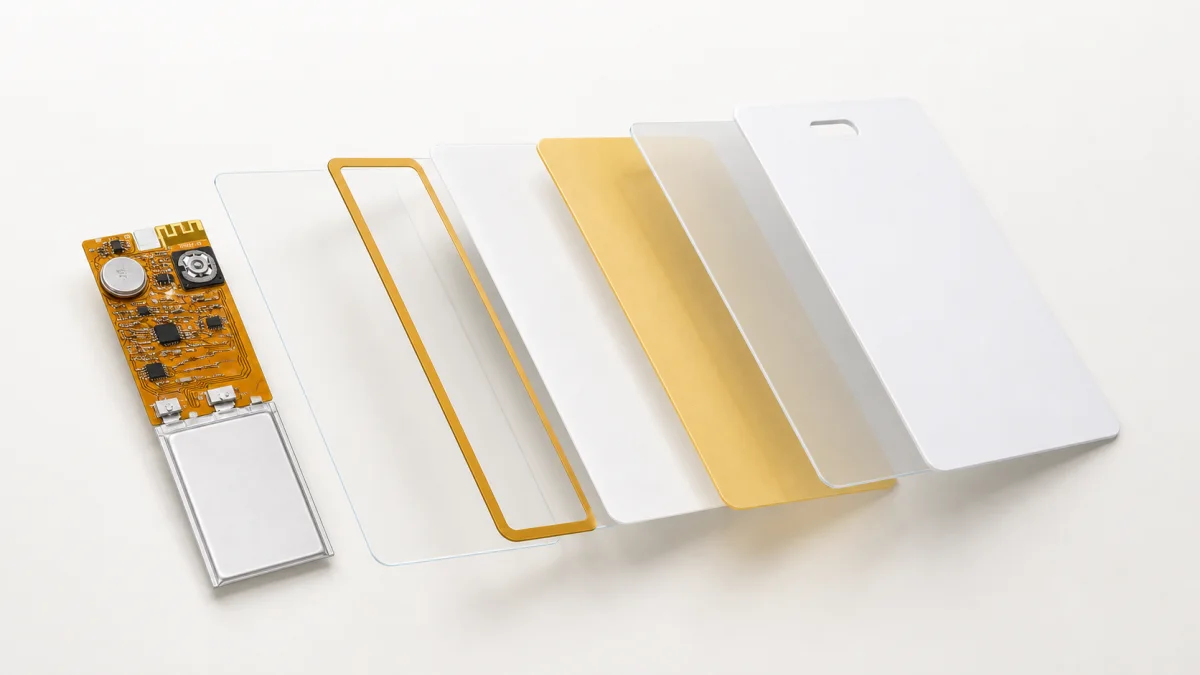
A cold-pressed sensor card combines the electronic assembly, battery and protective card body in a thin package. In Yuli's cold lamination smart card manufacturing process, room-temperature encapsulation and cold pressing provide an alternative to high-temperature card lamination for suitable electronic assemblies. The card artwork and outline can be customized around the approved electronics, sensing position and installation.
Cold pressing specifies the manufacturing process. The logger's operating temperature range depends on component and battery ratings, card materials and finished-card test results.
The electronics and battery set the minimum assembly height; the finished thickness also includes the card skins and encapsulation. A connector, battery tab or solder joint may be the highest point. The construction needs clearance for assembly tolerances and support that avoids concentrated pressure on the sensor package and battery connections.
PCBA cold-press integration should be reviewed before the card outline is finalized. An existing rigid PCB may already fit. A flexible circuit offers other options for sensor placement and local thickness, but introduces different assembly and handling requirements. Conversion to flex is unnecessary when the existing board meets the mechanical and sensing requirements.
Material compatibility sets the processing limits. Pressure, curing conditions and contact with encapsulants must suit the battery and components. The sensor area may require different protection from the rest of the electronics.
Temperature and humidity need different packaging
Temperature response through the card body
A temperature IC measures its own temperature. The PCB, battery, nearby electronics and card cover all influence how closely that follows the intended measurement point. For ambient monitoring, heat from the electronics should not dominate the reading. For surface monitoring, thermal contact with the target may be the priority. TI's PCB layout guidance for temperature sensors makes this distinction explicit.
Accuracy and response time are separate acceptance criteria. A card may settle to an acceptable reading yet react too slowly to a short temperature excursion. Compare the finished card with a reference through representative temperature changes, not only after a long soak at a fixed temperature. Changing the cover or encapsulant after that test can change the result.
Circuit-board thermal mass also affects response. TI's comparison of rigid and flexible boards examines this effect. The final response time must be measured after encapsulation, with the specified card materials and construction.
Water-vapor access for humidity sensing
A temperature-and-humidity monitoring card needs a sealing design that allows water vapor to reach the humidity sensor. An impermeable encapsulant over the sensing area would isolate it from the surrounding humidity.
A local opening and vapor-permeable membrane can protect a sensing area while preserving access to the environment. The cavity, membrane and nearby materials affect the result. Sensirion's humidity and temperature sensor design guide discusses these enclosure choices.
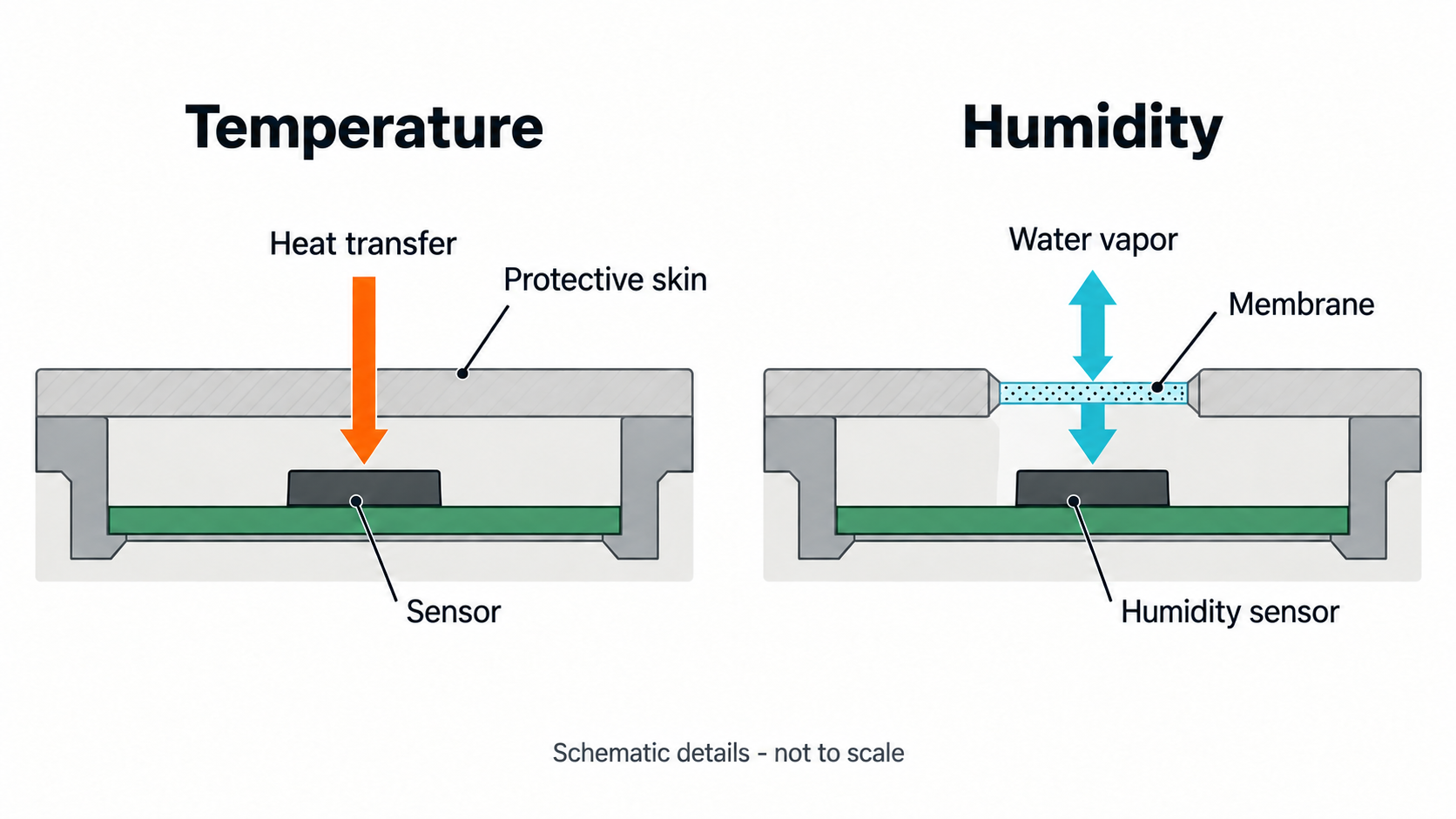
Adding humidity measurement changes the enclosure, cleaning limits and environmental test plan. The finished assembly needs checks for response and recovery after condensation, as well as compatibility with nearby materials.
BLE and NFC temperature loggers: data collection and readout
A battery-powered BLE temperature data logger can sample a sensor and store records while no phone or reader is nearby. An NFC temperature logger can also record locally and provide its stored history when read at close range. TI's NFC data-logger reference design illustrates this arrangement. NFC readout does not mean that continuous sensing and recording are battery-free.
For a brand building a monitoring service, three functions need to be defined:
- Recording: what the card measures, how often it samples, how timestamps are maintained and what happens when memory is full.
- Retrieval: whether a phone or reader obtains current values, stored history or both, and how an interrupted transfer resumes.
- Reporting: how the receiving device sends data to the customer's application, where alarms are evaluated and who receives them.
BLE advertising can carry a device identifier or selected current readings; a BLE connection can transfer stored history. NFC supports close-range identification, configuration or log retrieval according to the hardware and software design. The specification needs to state which functions are available through each interface.
Remote alerts during transit require an available reader and an onward network connection when the event occurs. A logger read only at delivery provides a retrospective record. The brand's phone application, fixed reader or receiving system handles data transfer to the monitoring service.
Production testing must verify data transfer through the specified interface and check the resulting records. Detection in a Bluetooth scan confirms only part of that operation.
Temperature excursions and trip records
An acceptable temperature at receipt does not rule out an earlier excursion. The receiving software needs the stored history, alarm thresholds and permitted time outside the limits to evaluate the shipment. Any recording delay at dispatch must also be accounted for.
Activation should be unambiguous: immediate start or a defined delay, with a clear status indication. Reusable cards need protection against overwriting an unread trip. Test the complete sequence with the intended reader, from configuration and activation through recording, download and trip closure.
Log capacity and recording interval
For example, a 30-day shipment logged once per minute produces 43,200 records. Assuming 16 bytes per record, the raw log requires 691,200 bytes, or 675 KiB. Configuration data, metadata and recovery functions require additional space.
Allow capacity for delayed collection, and define how the logger handles full memory, clock resets and interrupted downloads. Test these conditions before releasing the recording configuration.
Battery performance at low temperatures
Battery selection starts with the actual temperature profile, storage period and load. A thin cell that fits the enclosure may not sustain the radio's current pulses at the coldest operating point. Capacity measured under a supplier's room-temperature test is not a complete runtime estimate for a cold-chain journey.
Energizer's lithium coin-cell application manual describes temperature and pulse-load effects for that battery type. A thin-cell design needs data and load testing for the actual chemistry and format selected.
The power budget should separate storage, sampling, local writes, radio activity and user operations. For a reusable device, it also needs the time between trips. Long periods before deployment can matter even when an individual shipment is short.
The manufacturing sequence must specify battery attachment, programming and the state entered at first power-up. After programming, verify the storage or shipping mode and measure current consumption.
BLE and NFC testing after encapsulation
The battery's metal packaging, nearby conductors and card materials can affect antenna behavior. A successful read from a bare board is not enough to approve the packaged product. ST's dynamic NFC tag guidance, AN2972, emphasizes validation with the actual application and reader configurations.
Test the intended installation, including card position, orientation, holder and receiving device. The NFC read area must be accessible, and BLE transfers must work with the specified readers. Include foil-lined packaging and metal mounting surfaces wherever they are part of the application.
Record the firmware and assembly revisions, reader or phone model and test setup with each result. These details make wireless performance checks reproducible across production batches.
OEM/ODM manufacturing with your existing PCBA supplier
Keep your existing electronics supplier and use Yuli for customer-supplied PCBA encapsulation. Battery integration, programming and card production can be assigned separately to suit the supply chain.
| Manufacturing arrangement | Incoming assembly | Yuli's agreed scope |
|---|---|---|
| Card encapsulation and packaging | Programmed, tested assembly with battery already fitted | Incoming acceptance checks, cold-press encapsulation, final-card tests and packaging |
| Battery integration and card manufacturing | Assembled PCBA from the customer's supplier | Programming/configuration, battery attachment in the approved sequence, encapsulation and final tests |
| Complete manufacturing to approved design | Released design files and approved material specifications | PCBA assembly, programming, battery integration, card manufacturing, agreed tests and packaging |
Both suppliers need the same released drawings, assembly acceptance criteria and programming records. Assign responsibility for battery supply, failures found after encapsulation and approval of material substitutions. Quotations should cover the same work before their unit prices are compared.
For OEM/ODM sensor-card projects, separate one-time engineering and fixture charges from unit manufacturing costs. Include calibration, individual test records, serial-number printing and packaging where required. Compare cold lamination and molded housings on the total cost of building and validating the same product specification.

Design validation and production testing
Design validation establishes whether the finished card meets its requirements under the intended operating conditions. Production screening detects assembly and configuration faults against that approved design. Thermal-response studies and packaging trials belong in validation; routine end-of-line checks maintain production consistency.
The acceptance plan covers:
- Measurement: finished-card error at agreed points, response to temperature changes and, for humidity versions, response and recovery under the specified environmental conditions.
- Power: current in each operating state, startup behavior, battery voltage under representative load and the final shipping state.
- Data: recording interval, timestamp behavior, memory-full handling, restart behavior and complete retrieval after an interrupted transfer.
- Wireless: BLE/NFC operation after encapsulation and in the intended installation.
- Mechanical integrity: dimensions, flatness, bond integrity, attachment, handling and cleaning requirements.
- Traceability: the relationship between printed serial number, electronic identifier, firmware/configuration revision and the unit's test result.
Calibration requirements should identify the reference, measurement points, uncertainty, record format and recalibration policy. Component calibration covers the sensor itself; finished-device acceptance must also address the assembled card and its application. For regulated supply chains, the brand's quality team sets the required acceptance criteria and documentation before production.
Review Yuli's cold-press performance validation and testing capabilities when defining the manufacturing scope. Specify any sensor-specific fixtures, environmental tests or calibration services required for the project.
Request a custom temperature logger manufacturing quote
For a custom temperature logger card, Yuli can quote card encapsulation only, battery integration and card production, or complete manufacturing to your approved design. Identify which work you need and whether an existing PCBA supplier will remain involved.
Include these details with the inquiry:
- Application: shipment or storage monitoring, single-use or reusable operation, and where the card will be installed.
- Measurement: temperature only or temperature and humidity, operating range, accuracy and response requirements.
- Recording and readout: sampling interval, maximum journey duration, BLE/NFC functions and the intended reader or app.
- Assembly: card outline, complete assembly height, battery specification and whether the electronics are already designed.
- Supply scope: customer-supplied PCBA or full production, programming responsibility, prototype quantity and expected production volume.
- Acceptance: required tests, calibration documentation, device identification, print artwork and packaging.
For the engineering review, the supporting files are the schematic, BOM, PCB manufacturing files, assembly drawing and sensor and battery data sheets. Processing limits and any restricted material contact need to be included. These allow Yuli and your hardware team to agree the prototype build, fixtures and production tests before the card construction is released.
Discuss a temperature logger card project. For a detailed submission, use the project requirements form.