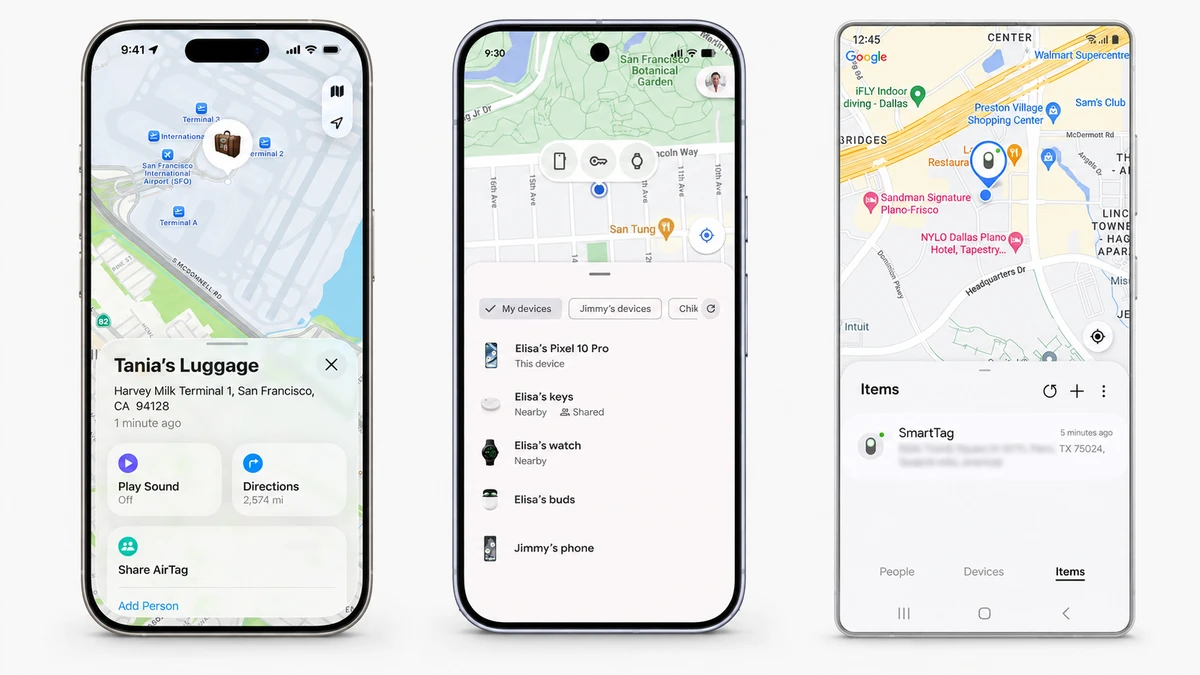
Two official updates in 2026 show where item trackers are heading. Apple extended the finding range and acoustic performance of its new AirTag, while Google added secure airline location sharing to Find Hub. Together, they move the category beyond placing a dot on a map. The product experience now extends from detecting a loss to helping the owner recover the item.
The change is bigger than stronger radio performance
Apple says its second-generation AirTag uses a new Ultra Wideband chip that lets Precision Finding guide users from up to 50 percent farther away than the previous model. An upgraded Bluetooth chip expands discoverability, while a revised internal acoustic design produces 50 percent more sound and can be heard from up to twice as far away.
Those figures describe Apple’s own product. They do not mean that every third-party Apple Find My accessory automatically gains the same UWB or Precision Finding capability. The broader signal for brands is that expectations are rising at every stage: a tracker must be discoverable at a distance, narrow the search nearby, and remain audible once the user reaches the area.
Airline workflows turn recovery into part of the product
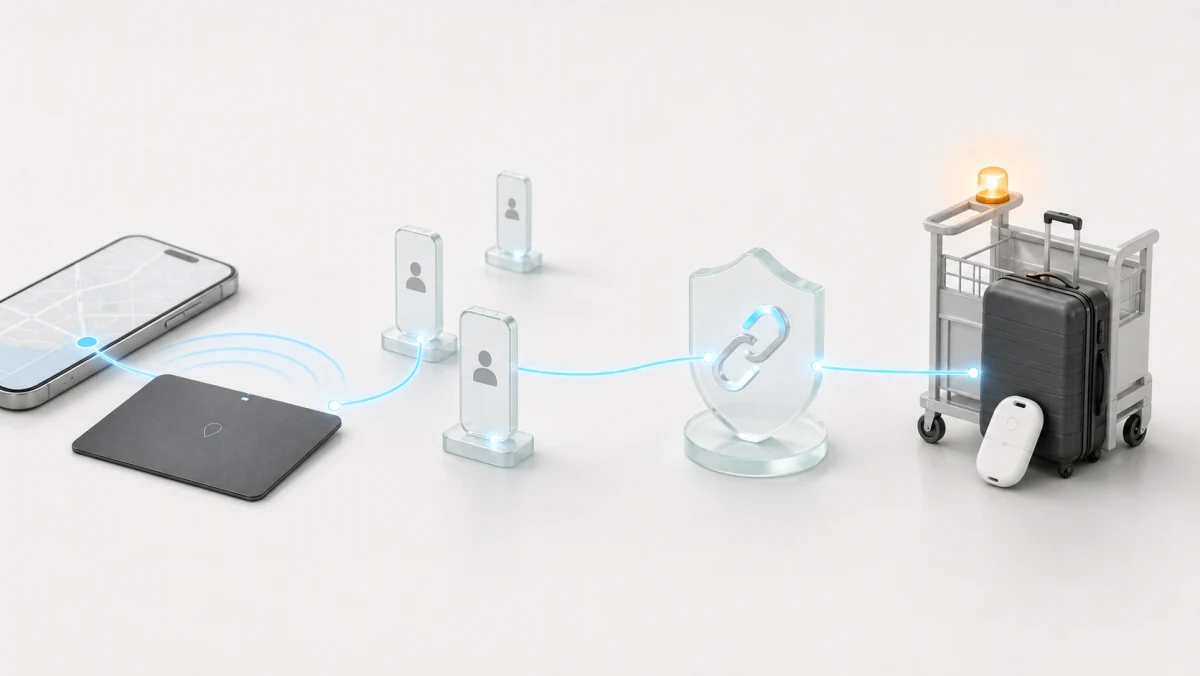
Apple’s Share Item Location lets a user temporarily share the location of a missing item with an authorized third party. Apple says more than 50 airlines accept these links. It also cites SITA data in which participating airlines reported 26 percent fewer baggage delays and 90 percent fewer truly lost or unrecoverable bags. Those are Apple and SITA figures, not results from Yuli projects.
Google began rolling out airline location sharing in Find Hub in March 2026. Owners can generate a secure URL for a compatible tag, submit it through a participating airline’s app or website, and stop sharing at any time. Both Apple Find My and Google Find Hub are connecting location data to an operational recovery process. Samsung SmartThings Find programs still require their own review around Galaxy users, nearby finding, platform access, and product requirements.
Five hardware areas deserve a fresh review
| Design area | Why it matters | What to validate |
|---|---|---|
| BLE antenna | Discovery is the entry point for remote and nearby recovery | Keep-out, material detuning, directionality, and finished-product consistency |
| Acoustics | Sound is often the final step once the location is close | Sound pressure, spectrum, openings, encapsulation clearance, and assembly loss |
| Battery and power | Advertising, connections, ringing, and recovery events change the energy budget | Real state machine, peaks, average current, and the conditions behind the battery-life target |
| Button and disablement | Pairing, reset, status, and unwanted-tracking protection need clear interaction | Travel, feel, accidental activation, firmware behavior, and platform rules |
| Card construction | Thin geometry intensifies conflicts between component height, radio, and sound | Joint DFM for the PCBA, battery, button, sounder, antenna, and cold-pressed stack |
Louder sound and longer battery life share the same limited budget
Sound output is not a transducer specification alone. In a thin tracker card, cavity volume, openings, face stock, adhesives, encapsulation, and the way the card is stored all change the result. Increasing drive power may improve short bursts, but it also raises peak current and battery stress.
A long-life FindMy tracker therefore cannot be specified from sleep current alone. Advertising, connections, security processing, buttons, ringing, recovery, and manufacturing tests should be measured separately using the final ecosystem firmware and representative finished construction.
Privacy and unwanted-tracking protection reach into hardware
Apple continues to emphasize end-to-end encryption, frequently changing Bluetooth identifiers, and cross-platform unwanted-tracking alerts. Google’s Find Hub sharing flow emphasizes user authorization, encryption, and the ability to stop access. These requirements influence device identity, secure storage, button actions, audible indications, reset behavior, and production-data control.
Which phone ecosystem does the product serve? Is it a card, tag, or embedded module? How will the user complete a nearby search? What are the battery-life target, launch markets, certification route, and platform applicant? Hardware and manufacturing gain a stable boundary only after those decisions are explicit.
What this means for OEM and ODM projects
An Apple Find My, Google Find Hub, or Samsung SmartThings Find route cannot be added after the hardware is complete. Target users, platform program, product form, energy budget, acoustics, security behavior, and certification documentation need to move together from project definition.
The customer owns product definition, industrial-design direction, brand, and channel. Yuli can support custom hardware, firmware adaptation, certification preparation, prototypes, pilot builds, and cold-pressed card manufacturing. For a standard tracker card, light-energy tracker card, or e-paper card, the PCBA, battery, sounder, button, antenna, and face materials must be validated together in the finished cold-pressed structure.