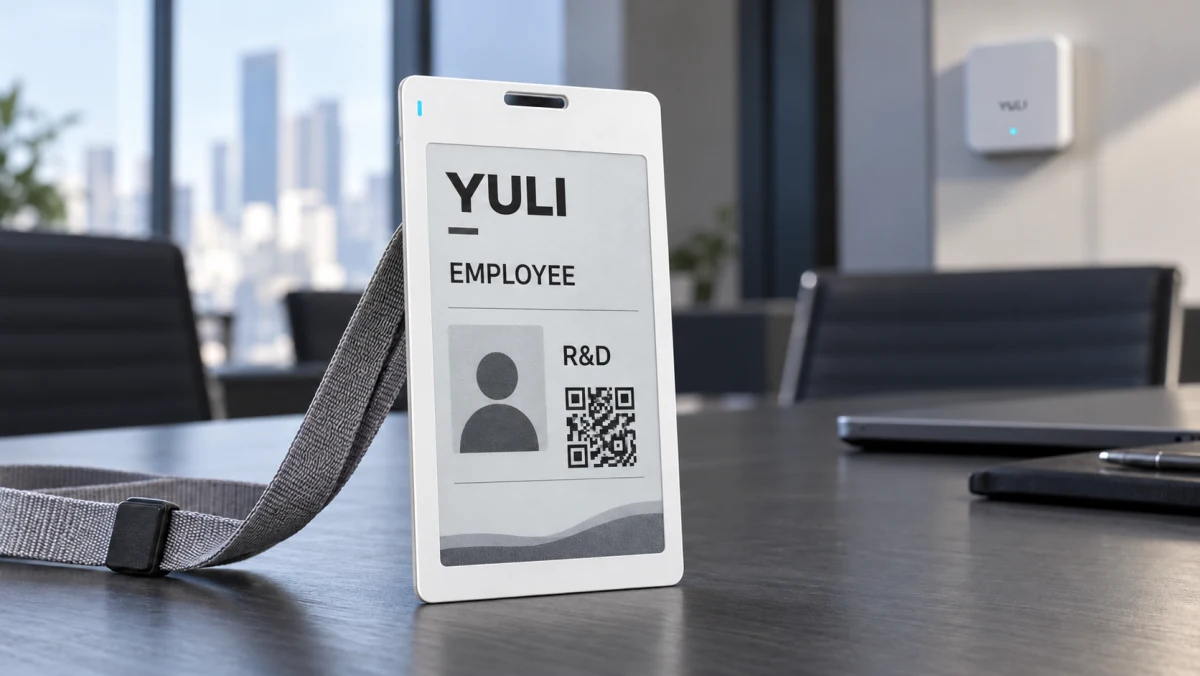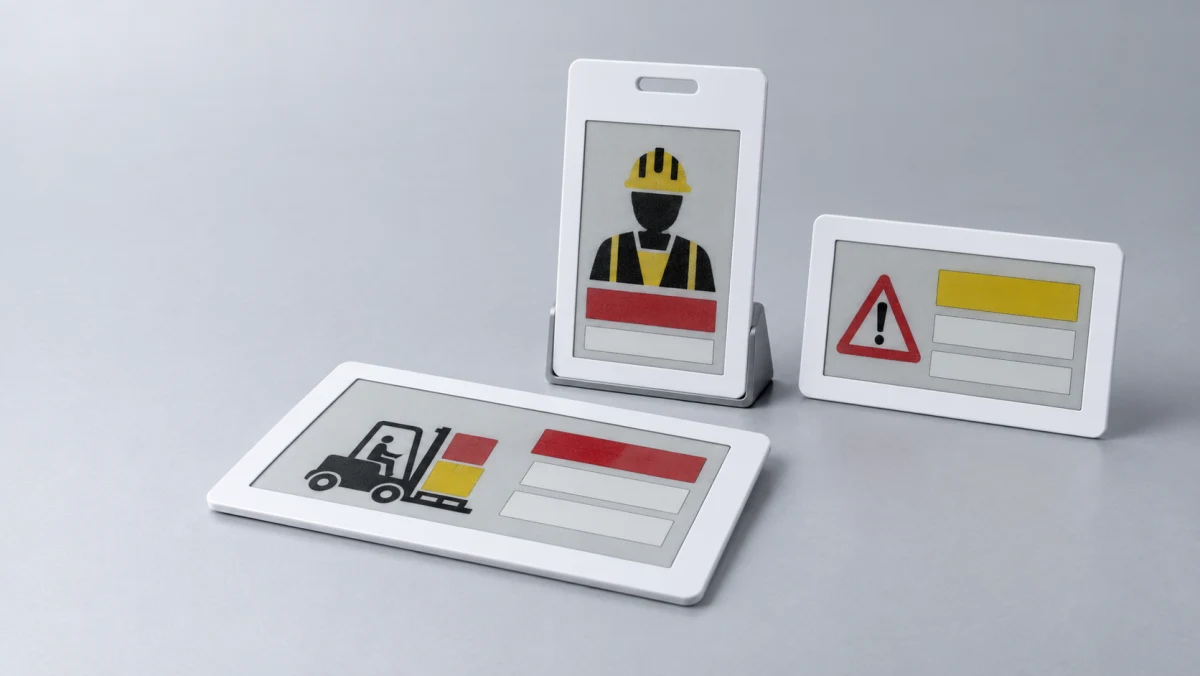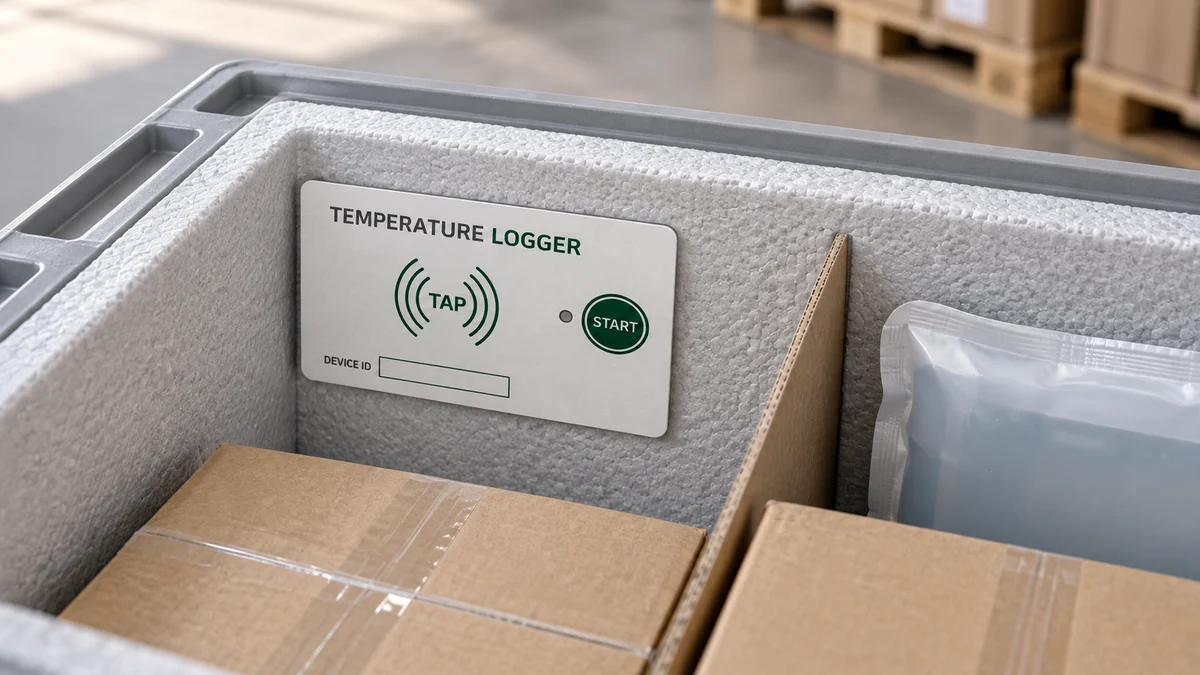
A Hubble Network pallet-tracking label has to make two handoffs correctly. It must stay attached to the pallet or returnable container through the route, and its electronic identity must arrive in the customer’s Hubble organization with the right serial number and production record. A thin BLE label solves the packaging problem only when radio performance, activation, provisioning and route validation are designed together.
Yuli supports flexible BLE label projects for brands, logistics platforms, pallet-pooling operators and returnable transport item programs. The scope can include label hardware, project firmware, samples, pilot builds, factory provisioning, serialization and finished-label production. The customer’s application, Hubble organization, operating rules and data workflow remain under the customer’s control.
A compatible device broadcasts an encrypted BLE advertisement. A nearby Hubble scanning gateway, which may be a smartphone or dedicated gateway, receives the packet and adds its own location, timestamp, signal strength and accuracy data before forwarding the record to Hubble. The reported position therefore comes from the scanner, not from a GPS receiver inside the label.
Hubble changes the network path, not the laws of radio
A Hubble-compatible label does not need a cellular modem or GNSS receiver to create a terrestrial detection event. It transmits a short BLE advertisement, and the network carries the captured packet to the customer’s application through an API or webhook. This keeps the device architecture small enough for labels, cards and embedded modules.
The network is still based on opportunistic reception. Detection is probabilistic: scanner density, scan timing, transmit power, advertising interval, mounting and the surrounding load all affect how often a device is seen. One missed packet is not a device failure, and a single successful bench capture is not route validation.
This distinction matters in logistics. A label may be tested in open air, then mounted against molded plastic, wood, corrugated board or a dense load. It may later be enclosed by stretch film, stacked beside other labels or placed near metal parts. The final radio profile must be approved on the actual pallet or returnable container, in the positions used during transport.
Why flexible BLE labels fit pallet and RTI programs
Reusable pallets, totes, crates and transport boxes move through mixed facilities. A rigid tracker can work well when the asset has a protected mounting pocket and a long service life. A flexible BLE label is useful when the device must stay close to an existing identification label, add little height and move through current packing and handling processes.
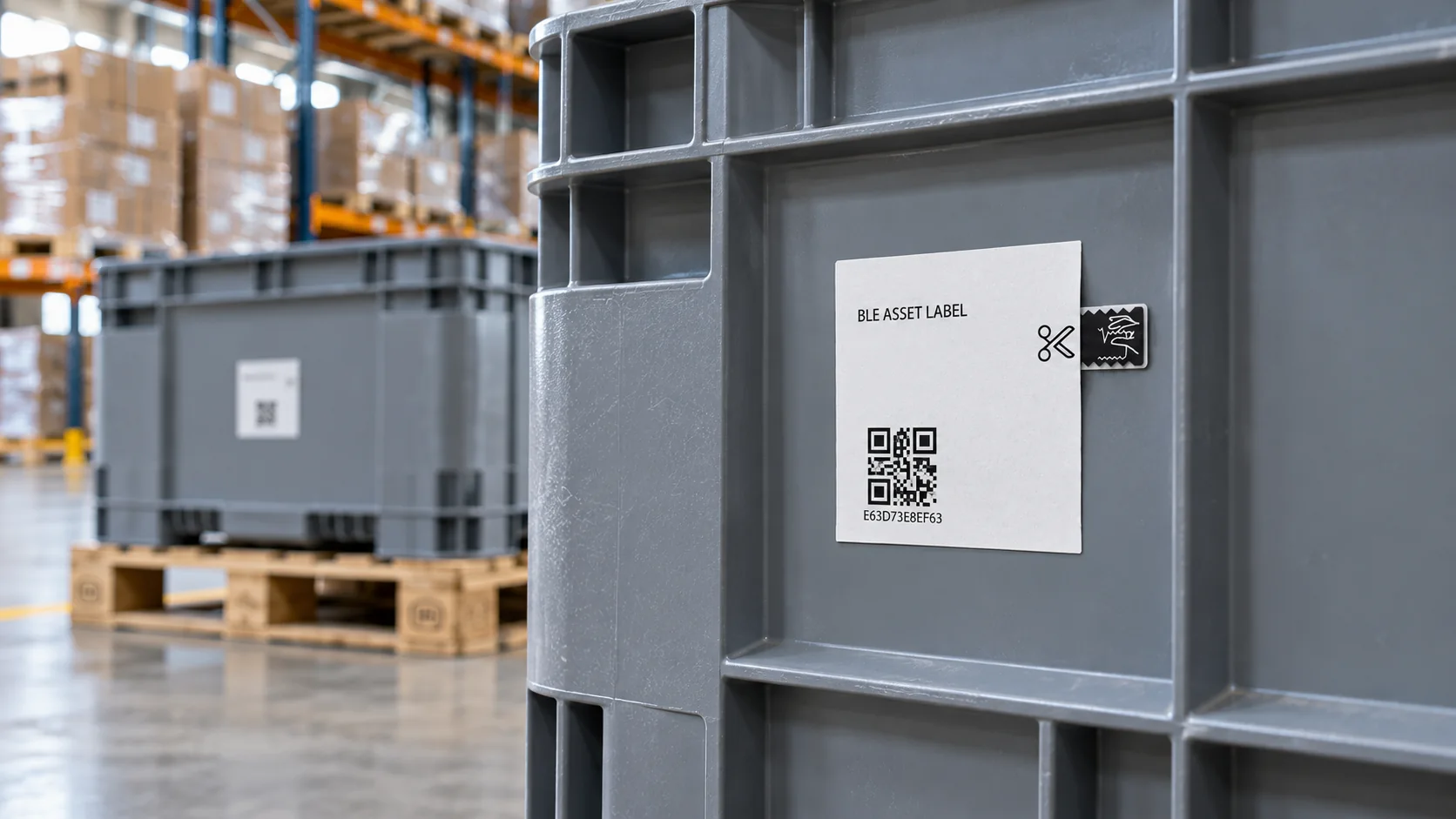
The label can combine the radio device with printed information such as a QR code, serial number, asset ID or customer artwork. That does not make the printed identity and electronic identity interchangeable. The manufacturing record must link them so a scan on the pallet, a Hubble packet and the customer’s asset record refer to the same unit.
| Product form | Best fit | Design priority | Typical service decision |
|---|---|---|---|
| Flexible BLE label | Pallets, totes, cartons and returnable packaging with a flat mounting area | Low profile, adhesive system, antenna clearance and activation | Finished label or electronic inlay supply |
| Cold-pressed BLE card | Reusable assets that need a defined card body, printed finish or protected embedded electronics | Flatness, encapsulation, edge quality, RF after pressing and mounting method | Complete card manufacturing and production test |
| Rigid replaceable-battery tag | Long-life reusable assets with room for a housing and battery service | Enclosure, sealing, battery access, mounting and impact resistance | Device service and battery replacement plan |
Yuli’s flexible Bluetooth label manufacturing route is intended for low-profile electronic labels. When the project needs a firmer body or more protection around the electronics, the same network work can move into a cold-pressed smart card or another project-specific format.
The label specification starts with the route
Label size is only one input. A pallet program also needs the active transport period, pre-activation storage time, mounting surface, temperature range, route geography, expected scanner environment and required detection frequency. These conditions set the practical power and radio targets.
Battery and activation
A thin primary battery can support a short- or medium-duration logistics program without the height of a coin cell. The available energy has to cover BLE advertising, any sensing or local processing, and the required margin at the lowest operating voltage. Shipping mode and activation method are equally important because a label that begins advertising too early spends part of its energy before the pallet enters service.
Cut-to-activate, tear-to-activate and pull-tab constructions serve different packing workflows. The activation feature should be clear to the operator, hard to trigger accidentally and compatible with label converting. Its state should also be testable during production without consuming an unreasonable share of the service life.
Antenna placement and mounting
The antenna is validated with the selected battery, face stock, adhesive, liner and mounting surface. A layout that performs well on the bench can lose margin when the label is placed against dense product, liquid, metal or a deep molded rib. The mounting position therefore belongs in the engineering drawing and the pilot instructions.
Transmit power and advertising interval are set as a pair. More frequent transmission increases the chance of overlapping a scanner window but consumes more energy. Higher output may improve discoverability in difficult surroundings, yet the gain must be checked against the approved radio, battery and regulatory design. A final value cannot be selected from the network name alone.
Finished label or electronic inlay
A finished label arrives with the approved face material, print, adhesive construction, battery, activation feature and final test. It gives the brand one released article for application to the pallet or container.
An electronic inlay separates the electronics from final label converting. A battery-included inlay can be supplied electrically tested, after which the customer’s converter adds the agreed face stock, adhesive, liner, printing and die cutting. A battery-ready inlay leaves battery sourcing, connection and associated testing to the downstream process. These routes have different ownership, test points and quotations; they should not be treated as the same product.
Provisioning establishes device ownership
Each production unit needs its own Hubble device identity. Registering and provisioning the device for the customer’s organization during manufacturing creates a cleaner production handoff. The customer can provide a narrowly scoped manufacturing API token for ongoing production or a controlled list of pre-registered keys for a fixed run.
This step should be designed before the pilot is built. Some firmware and hardware configurations do not provide a practical way to write the device key after final assembly. Factory provisioning avoids a manual backend handoff and lets the label ship already assigned to the correct organization.
A production manifest can connect the printed serial number, customer asset ID, hardware ID, Hubble device ID, firmware revision, production batch and final test result. Secrets are handled through the agreed secure process; the visible manifest should carry the identifiers needed for receiving and traceability, not expose device keys.
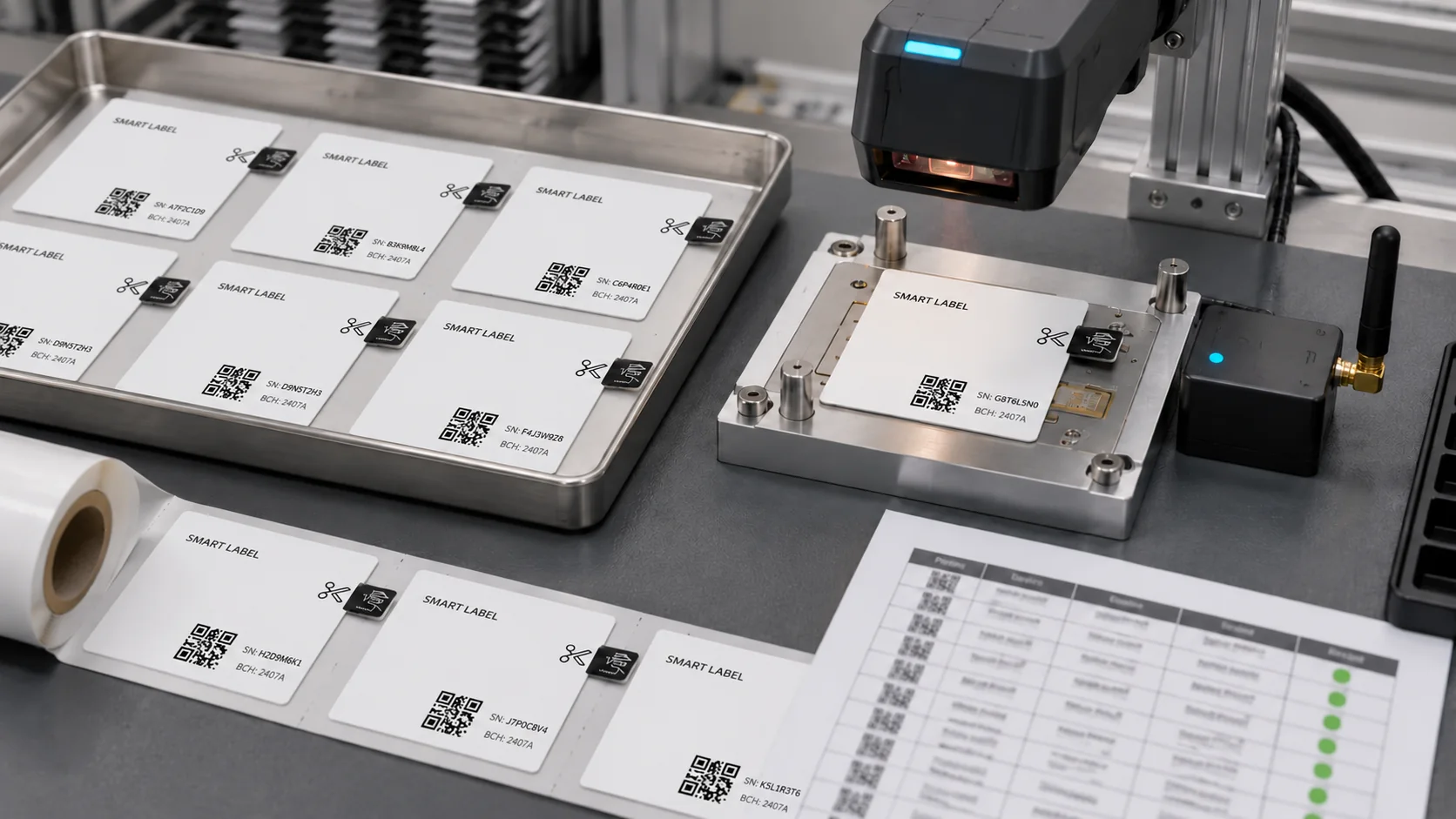
A serious pilot tests the load, route and data
A pilot of several hundred or one thousand labels is not an oversized laboratory test. It is the first production run, and it should expose manufacturing variation as well as network behavior. The pilot plan needs acceptance criteria before labels are released.
1. Bench and production checks
Confirm activation, current profile, advertising content, transmit power, serial mapping and final-test yield. Samples from the start, middle and end of the run should be compared for dimensional, print and electrical consistency.
2. Customer-organization reception
Provisioned devices are checked in the customer’s Hubble environment. The team confirms that expected packets are received, the right customer identifiers are returned and API or webhook data reaches the intended application. This is also where ownership mistakes are found before the units leave the factory.
3. Mounting study
Test the approved label positions on empty and loaded pallets or containers. Compare side walls, recessed panels and other practical locations. Record orientation, load material, neighboring labels and the condition of stretch wrap or covers; otherwise, range numbers cannot be reproduced.
4. Route trial
Run labels through the terminals, warehouses, yards and vehicles used by the program. Evaluate detection frequency and data latency over several days rather than judging the network from one pass. Hubble advises that detection rate varies with scanner density and environmental conditions, and that colocated devices can produce different packet counts.
5. Data treatment
The application may receive duplicate captures, location outliers or delayed records from scanners reconnecting to the network. Hubble’s guidance recommends filtering duplicates, checking timestamps, flagging unrealistic jumps and aggregating detections over a period suited to the use case. These rules belong in the application layer, not in a marketing claim about the label.
Terrestrial support does not make a label satellite-ready
Hubble’s Terrestrial and Satellite networks have different device requirements. A standard low-power BLE label can be developed for the Terrestrial Network because that path uses ordinary BLE advertisements received by nearby scanners. Satellite transmission requires a supported radio platform, much higher output power, suitable antenna performance and a power source able to supply the peak current.
Satellite coverage should therefore be treated as a separate hardware architecture and qualification program. It must not be added to a flexible-label data sheet merely because the terrestrial firmware uses the Hubble protocol.
Where cold-pressed cards fit
A cold-pressed card is useful when the device will be handled repeatedly, carried by a person, inserted into a holder or mounted where a defined flat body gives better protection and presentation than a converting label. It can integrate the BLE PCBA, battery, button, buzzer, NFC or sensors inside a finished card body, subject to the released project design.
For teams starting a Hubble project, a cold-pressed card can also serve as an engineering platform while the flexible label construction is being finalized. Network integration and customer-organization reception can be verified first, then the approved radio and identity flow can move to the production-intent label. The label still requires its own power, antenna, mounting and route validation.
Information needed for a Hubble BLE label RFQ
- Tracked asset, mounting surface and label position.
- Countries, facilities and transport routes in the pilot.
- Active trip duration, storage period before activation and target service life.
- Required Hubble payload, reporting objective and customer-application interface.
- Transmit power, advertising interval or detection requirement, if already defined.
- Finished-label, battery-included inlay or battery-ready inlay supply.
- Printed serial format, QR code, customer asset ID and required production manifest.
- Pilot quantity, volume forecast, schedule and acceptance tests.
Yuli can review these inputs against an existing flexible BLE label platform or a custom hardware route. The first engineering review should also identify what is already confirmed, what must be tested on the customer’s load and which Hubble access or provisioning material the customer will provide.
Frequently asked questions
Does a Hubble BLE label contain GPS?
Not necessarily. On the Hubble Terrestrial Network, the scanner that receives the BLE advertisement supplies the reported position and time. A thin pallet label can therefore operate without a GPS receiver, while accuracy and detection frequency depend on the scanner and environment.
Can a brand keep its own BLE service alongside Hubble?
Yes, if the selected hardware, packet plan, firmware and power budget support it. Hubble documents both broadcast-only and connectable BLE configurations. A brand-specific service can be retained for local configuration or an application workflow, but coexistence and current consumption must be validated on the released firmware.
Should device keys be written after delivery?
Factory provisioning is normally the cleaner production route. It assigns each device to the customer’s Hubble organization before shipment and allows identity and packet reception to be checked during final test. Post-delivery writing depends on firmware and hardware support and should not be assumed.
Can open-area BLE range predict performance inside a loaded trailer?
No. Cargo density, metal, liquids, pallet geometry, label position and neighboring transmitters can all change reception. Loaded-pallet and route trials are required before the radio profile and detection expectation are released.
Discuss a Hubble Network BLE label project. For a detailed submission, use the project requirements form.