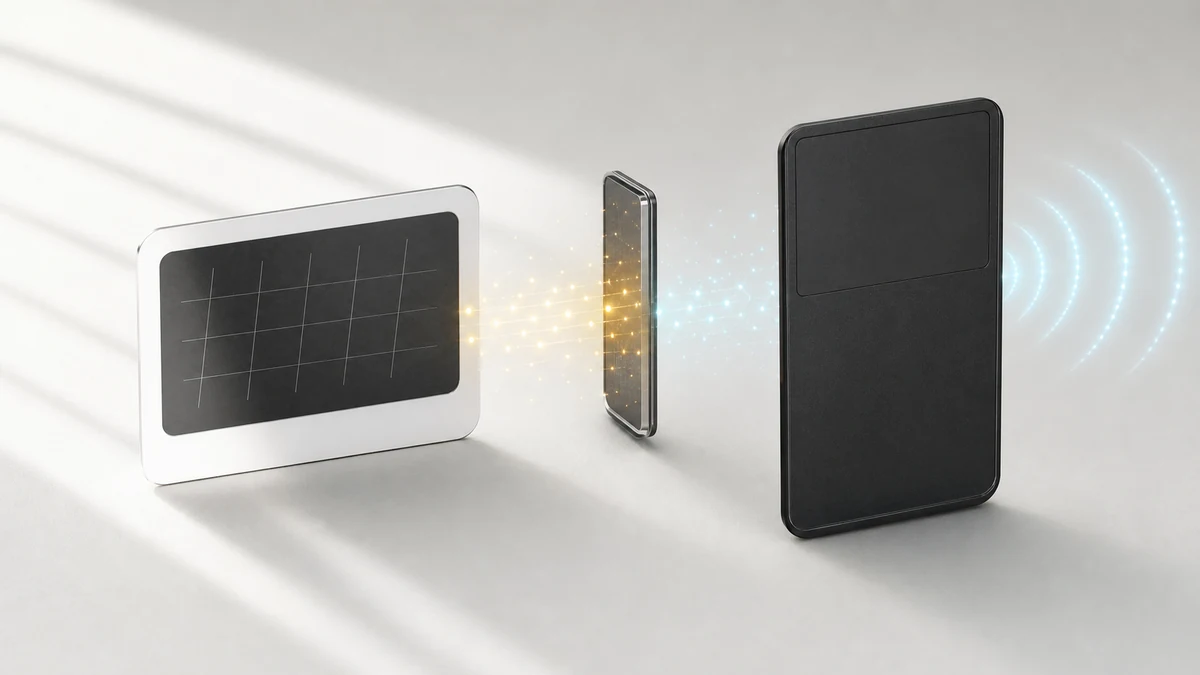
Ambient light can supplement the energy used by a tracker card, but a photovoltaic element does not create unlimited battery life. The design must balance three sides of one budget: how much energy is collected, how much can be stored, and how much is consumed by BLE advertising, connections, buttons, and ringing.
Begin with representative illumination
Outdoor sunlight, indirect window light, office lighting, and storage inside a drawer differ by orders of magnitude. Photovoltaic area, orientation, shading, temperature, and conversion efficiency further reduce useful input. A project should record illumination ranges and daily exposure time rather than relying on a photovoltaic device’s peak figure under ideal laboratory conditions.
A tracker’s load is not constant
The device spends most of its time sleeping or advertising periodically, while pairing, identity rotation, button events, ringing, synchronization, and abnormal wakeups create short peaks. An average-current model must weight each state by frequency. Using only the SoC sleep-current figure produces an optimistic result.
Storage covers the hours without light
Energy-harvesting products still need storage for night-time use, transport, warehousing, and extended shading. A rechargeable thin cell or alternative storage device should be selected by thickness, cycle life, self-discharge, charging temperature, and protection requirements. In a card, storage area and compression behavior also affect the cold-press structure.
| Record | What to capture |
|---|---|
| Illumination | Lux range, daily duration, angle, shading, and test location |
| Harvesting | Active PV area, conversion efficiency, cold start, and low-light output |
| Storage | Capacity, initial charge, self-discharge, efficiency, and temperature |
| Device load | Sleep, advertising, connection, ringing, button, and abnormal events |
| Result | Daily net energy, dark runtime, and minimum storage margin |
Decide whether the budget closes
Start with a worst credible case, such as several days in a low-light environment, and verify that essential advertising and finding functions remain available. Then test whether normal daily exposure replenishes the energy used. A product that depends on continuous photovoltaic input in the worst case has very little operating margin.
Engineering support from Yuli
Yuli can support low-power hardware, firmware-state modeling, photovoltaic and storage selection, prototype current measurement, card integration, and cold-press pilot production. Any battery-life statement should remain tied to a defined hardware and firmware version, storage capacity, advertising strategy, and illumination profile.