Most BLE tracking projects begin with a product shape: a tracker card for a wallet, a smart label for logistics, a tag for keys, or a small PCBA that needs to fit inside another device. That is a natural starting point, but it is not enough for an OEM or ODM project.
The project depends on the system behind the product. Who will use it? Which app or platform owns the location experience? Does the product need Apple Find My, Google Find Hub, Samsung SmartThings Find, or a private BLE platform? How long should the device run? Which certification route applies to the final branded product? Can the structure survive production, bending, adhesive use, temperature change and daily handling?
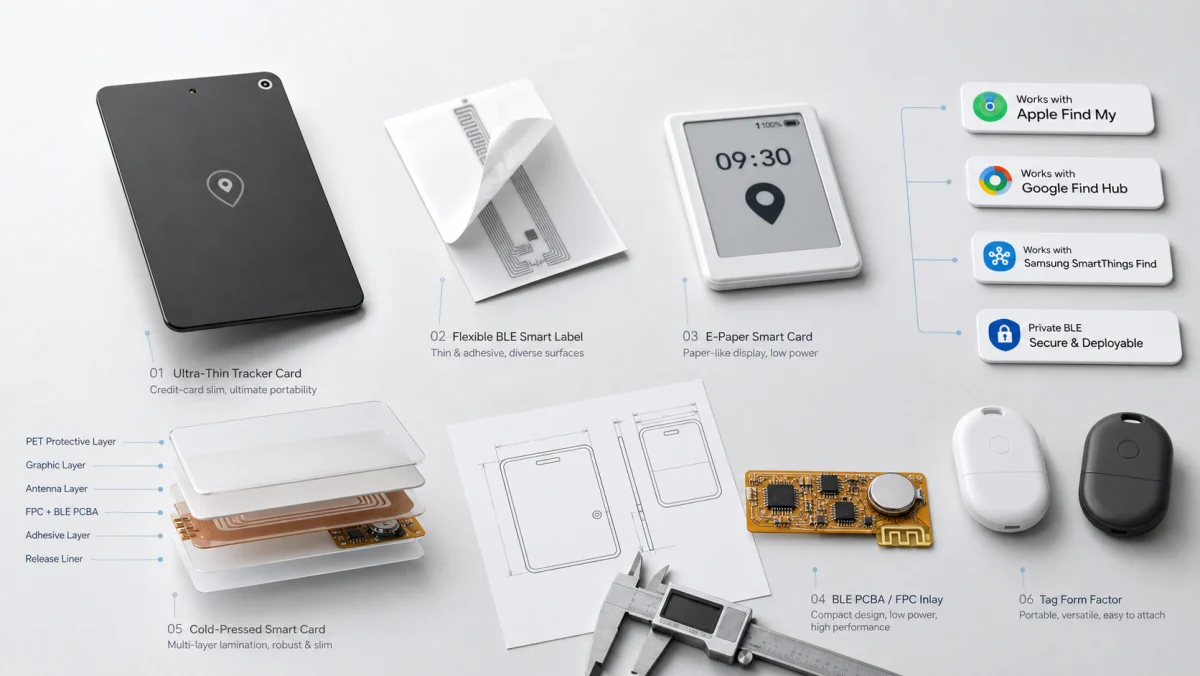
Yuli supports OEM/ODM BLE tracking cards, flexible BLE labels, smart badges, tag form factors, embedded PCBAs and cold-pressed smart card manufacturing. Before quoting a shell, the team should choose the right product route.
Start with the use case, not the enclosure
The same BLE chipset can end up in very different products. A wallet card, a warehouse label and an e-bike tracking module may all use Bluetooth Low Energy, but the mechanical structure, battery strategy, antenna layout, data flow and certification plan are not the same.
For a wallet or card-holder product, the buyer normally cares about thickness, surface finish, buzzer sound, charging method, NFC area, button feel and long battery life. For a logistics or packaging label, the buyer may care more about adhesive reliability, device ID mapping, scan method, gateway coverage, unit cost and whether the label can move through packing and distribution without being damaged. For a workforce card or smart badge, the project may involve BLE, NFC, identity information, access-control interaction, check-in logic and a display surface. For an embedded PCBA, the first questions are usually power supply, antenna keep-out, host-product enclosure, pairing retention and regulatory boundaries.
This is why an OEM BLE tracking product should be evaluated as an application route before it is treated as a finished item.
| Application | Likely product route | Questions to settle before RFQ |
|---|---|---|
| Wallets and slim accessories | Tracker card | Thickness, charging or primary battery, buzzer, button, Find ecosystem route, branding |
| Logistics and retail packaging | Flexible BLE smart label | Adhesive stack, label life, QR/SN mapping, scan method, gateway or mobile app, API needs |
| Workforce and site access | Smart badge or BLE + NFC card | NFC use, BLE services, battery status, display, access workflow, card durability |
| Care products and key items | Tag, pendant or small tracker | Button, buzzer, water resistance target, battery replacement, sensor requirements |
| E-bike, controller or battery pack | Bare BLE PCBA or FPCB inlay | External power, antenna location, host enclosure, RF validation, certification scope |
| Customer-supplied electronics | Cold-pressed smart card integration | PCBA height, thin battery, antenna shift, flatness, pressure, finished-card reliability |
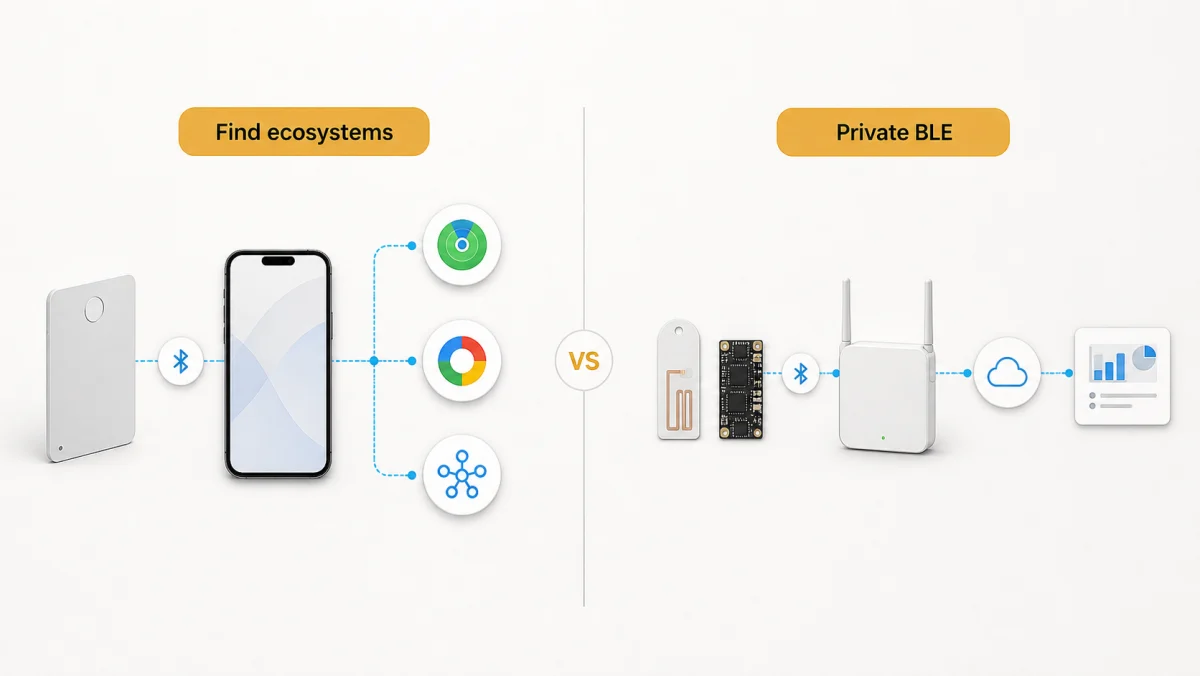
Official Find networks and private BLE platforms are different choices
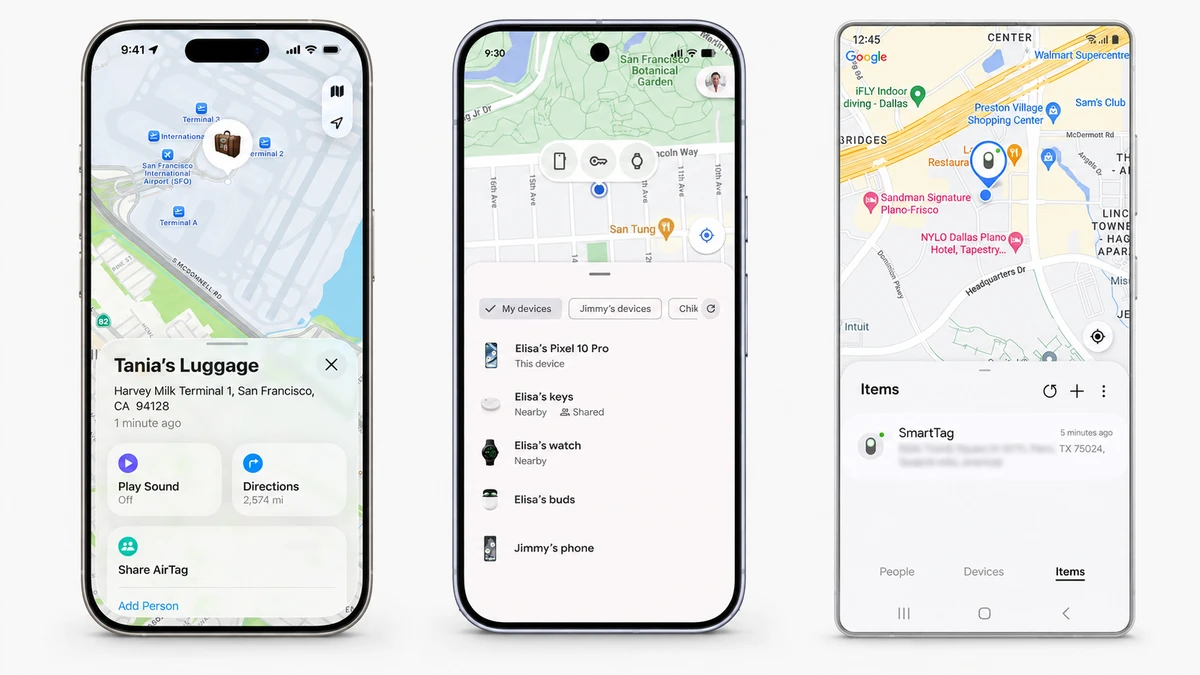
One of the most common mistakes in BLE tracking projects is to treat every “find” product as the same architecture. Apple Find My, Google Find Hub and Samsung SmartThings Find are official consumer finding ecosystems. They make sense when the end user needs to find personal items through a platform experience they already trust.
That is a different problem from enterprise asset tracking.
An official Find ecosystem route usually involves platform rules, privacy requirements, account or program responsibilities, acoustic behavior, sensor or anti-stalking requirements, provisioning, and project-specific certification or authorization work. It is not the same as building an open logistics platform where the customer receives every scan event in its own backend.
A private BLE platform is the better route when the buyer needs device IDs, QR or serial-number mapping, battery status, gateway observations, last-seen events, MQTT, webhook delivery, a customer app, a dashboard, or integration with a warehouse, SaaS or field-service system. In that case, the BLE device becomes a data node. The mobile app, BLE gateway and backend define the operating model.
For buyer planning, the practical distinction is simple: Apple Find My, Google Find Hub and Samsung SmartThings Find are designed for end-user item recovery inside their own ecosystem experiences. A private BLE platform is designed for customer-owned data flows, such as gateway scans, device ID mapping, battery state, event history and webhook/API integration. Some projects evaluate both routes, but they should be planned as separate technical and compliance paths.
When a Find ecosystem makes sense
A Find ecosystem route makes sense when the product is meant for consumer item recovery: wallets, luggage, bags, keys, bikes, small personal accessories or other products that end users expect to locate in an existing platform app.
For these projects, the buyer should define the target ecosystem early. A product designed around Apple Find My should not be casually described as the same product as a Google Find Hub tracker or a Samsung SmartThings Find tracker. Hardware, onboarding, testing, acoustic behavior, pairing experience, user instructions and certification support can differ by route. A buyer should also confirm who owns the brand, who manages the platform account or authorization process, and which entity is responsible for the final sales market.
Yuli’s role is to support solution customization, hardware engineering, low-power evaluation, antenna and acoustic integration, sample builds, pilot production, certification support and manufacturing handoff. The customer’s role is to define the product, brand, market, channel and official ecosystem responsibility for the project.
When private BLE is the better route
Private BLE is often the right choice for logistics, asset management, field service, workforce operations, industrial equipment, inventory control and SaaS-connected products. These applications usually do not begin with “Where is my item in the Find app?” They begin with operational questions:
- Which asset moved?
- Which gateway saw it?
- When was it last detected?
- What is the battery level?
- Which QR code or serial number maps to which device ID?
- Should the device broadcast all the time, or only after motion?
- Does the customer app need to read or write settings through GATT?
- Should the backend receive events through a webhook or API?
For these projects, the product may still look like a card, tag or label, but the value is in the data route. A flexible BLE label for a carton, for example, is closer to a packaging and data-capture product than a consumer tracker. A bare PCBA inside an e-bike battery pack is closer to an embedded wireless module than a stand-alone tag.
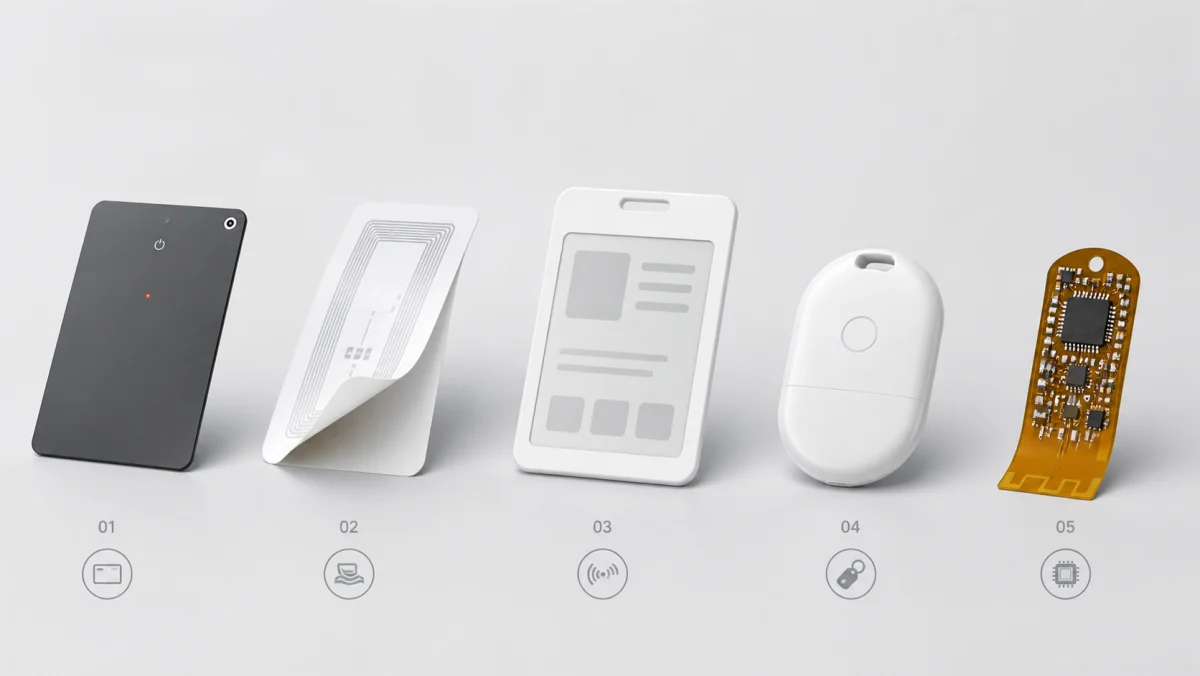
Product form options for OEM projects
The product form should follow the use case. A good OEM discussion should not force one shape onto every project.
Ultra-thin tracker cards
Tracker cards fit wallets, card holders, luggage tags, employee accessories and slim branded products. The engineering work is mainly about keeping the device thin while protecting the antenna, battery, buzzer, button, charging area or NFC area.
For an Apple Find My tracker card, Google Find Hub tracker card or Samsung SmartThings Find route, the ecosystem decision should be made before tooling and mass production planning. For a private BLE tracker card, the buyer should prepare the required BLE services, GATT behavior, battery reporting method, app workflow and backend requirements.
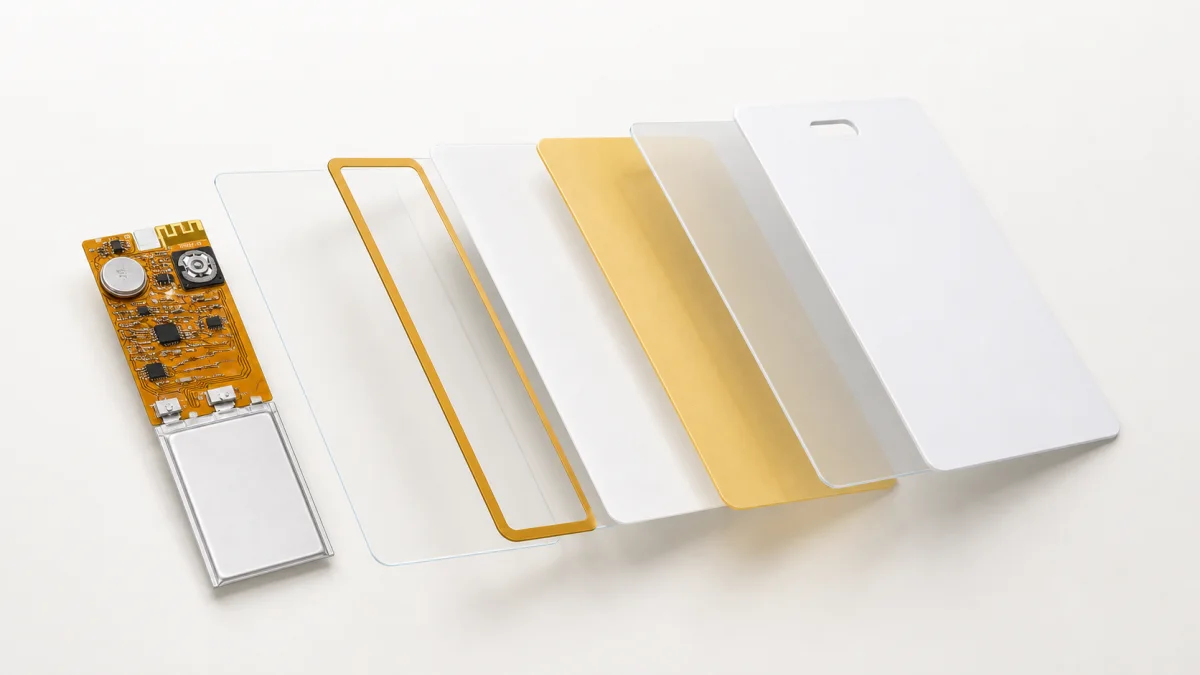
Cold-pressed smart card manufacturing is relevant when the product needs a finished card body rather than a simple plastic enclosure. The card body must protect the electronics without damaging RF performance, button response, sound output or surface flatness.
Flexible BLE smart labels
Flexible BLE labels are used when a tracking product must behave more like a label than a conventional device. Common search terms include flexible BLE label, adhesive BLE smart label, BLE printable asset label, Bluetooth asset label and smart logistics label.
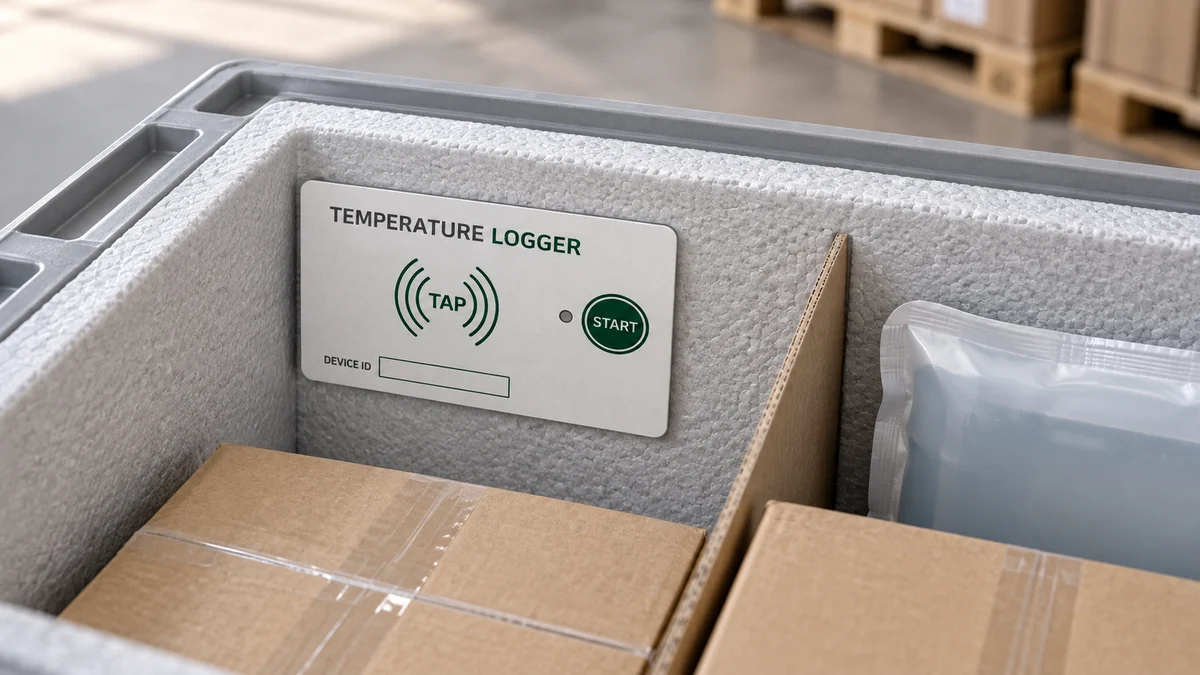
These labels are usually evaluated around attachment method, thickness, label material, battery life target, broadcast content, ID mapping and production handling. A warehouse or logistics customer may not need a consumer Find ecosystem at all. It may need a label that broadcasts a defined ID, a mobile app or gateway that captures that signal, and a backend that turns detections into usable events.
The buyer should define whether the label is applied to paper cartons, plastic bins, luggage, pallets, retail packaging, tools or equipment. The RF result can change depending on the surface, especially near metal, liquid, dense goods or large battery packs.
Smart badges and BLE + NFC cards
Smart badges and BLE + NFC cards are a better fit when the product must support identity, access, check-in, personnel location, or visual information. A smart badge project may include NFC, BLE advertising, GATT commands, a buzzer, a display, battery status and customer-specific ID data.
These projects often require tighter coordination between the customer’s platform and the hardware team. The card may need to work with access systems, mobile apps, gateways, dashboards or site-management rules. The best RFQ is not just a picture of a badge. It includes the workflow the badge must support.
Tags, pendants and care devices
Small tags, keychain trackers and care-oriented devices have different priorities. They may need stronger acoustic output, a physical button, a replaceable battery, a larger antenna area, a sealed housing, a lanyard hole, a clip or a wearable structure.
Some buyers ask for fall detection, SOS behavior or sensor-based logic. These should be treated as project-defined features, not universal promises. The sensor, algorithm, use environment, false-alarm tolerance, battery budget and test method all need to be defined before the feature becomes part of the product specification.
Bare PCBAs and electronic inlays
A bare BLE PCBA or FPCB inlay is suitable when the customer already has an enclosure, product housing, battery pack, controller, card production line or mechanical structure. In these projects, the BLE device is not the final product. It is a component inside a larger system.
The key work is RF integration. Antenna keep-out, ground plane, battery position, cable routing, enclosure material and nearby metal can all change performance. If the PCBA uses external power, the voltage range, current budget, startup behavior and host-system interaction must be defined. If the project uses a certified module or a previous RF design, the team still needs to check whether changes to antenna, layout, enclosure or firmware affect the final compliance path.
Customer-supplied PCBA to finished smart card
Some buyers do not need Yuli to design the full electronics. They need an existing PCBA, FPCB, thin battery or electronic inlay turned into a finished smart card.
This is where cold-pressed card manufacturing becomes a different capability from conventional card printing. Embedded electronics create local height, pressure, adhesive, antenna and thermal challenges. A card with a battery, buzzer, e-paper area, NFC antenna or BLE antenna cannot be treated like a plain plastic card.
The practical questions are simple: How high are the components? Where is the battery? What material surrounds the PCBA? Can the antenna still work after encapsulation? How much bending can the finished card tolerate? What happens to the button, sound hole, charging area or display window after the card body is formed?
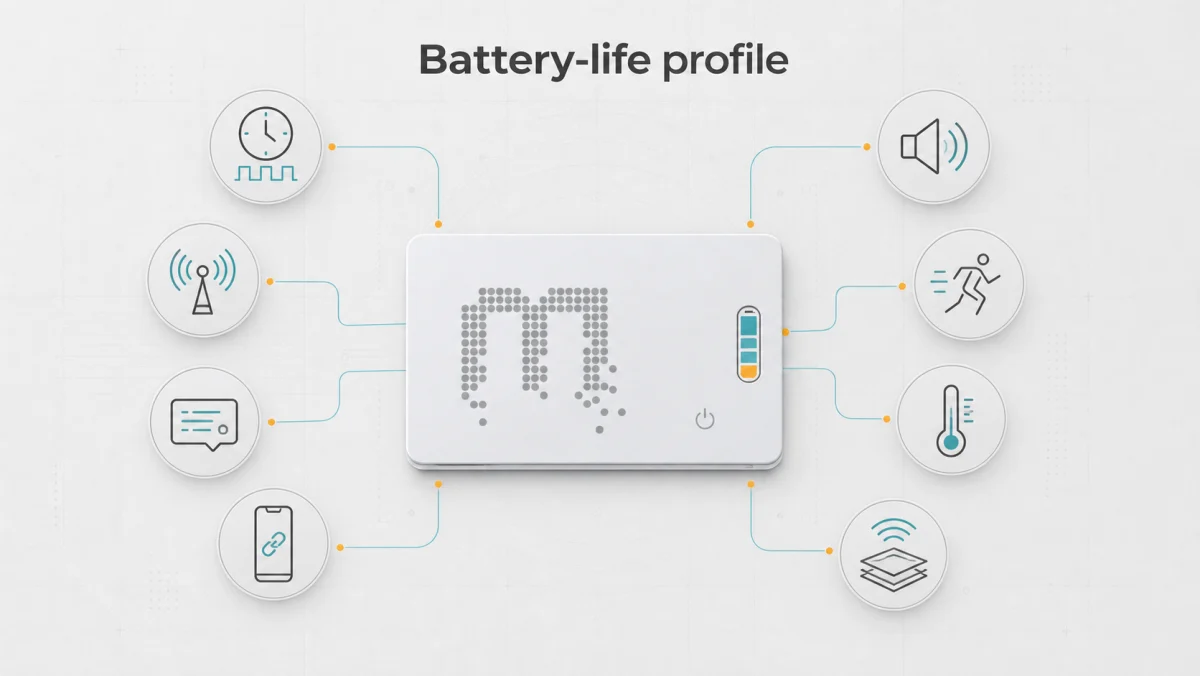
Battery life is an engineering profile, not a single number
Battery life is often the first number buyers ask for, but it is also one of the easiest numbers to misunderstand.
A BLE tracker does not consume one fixed current all the time. Its average current depends on advertising interval, transmit power, payload, connectable or non-connectable mode, GATT connection frequency, sensor sampling, buzzer use, LED behavior, OTA updates, temperature and the RF environment. A product that advertises frequently so it can be detected faster will not have the same battery life as a product that advertises slowly. A label that must support high-volume logistics may use a different battery strategy from a rechargeable tracker card for a premium accessory.
| Design factor | What it changes |
|---|---|
| Advertising interval | Shorter intervals improve discovery but increase average current |
| TX power | Higher output can improve scanning range but uses more energy |
| Payload and multi-advertising | More data or multiple advertising sets can increase scheduling load |
| GATT sessions | Useful for setup and commands, but connection frequency matters |
| Buzzer and LED | Short high-current events that must be budgeted separately |
| Sensor sampling | Motion, temperature or tap features depend heavily on sampling strategy |
| Temperature | Battery behavior changes in hot, cold or storage conditions |
| Product structure | Antenna, battery and materials can change real-world range and duty cycle |
For a serious RFQ, it is better to provide a target use profile than to ask for a single lifetime number. A useful profile says how often the product advertises, whether users connect to it, how often the buzzer is triggered, what battery type is expected, where the product is used, and what margin the customer needs before mass production.
Certification and brand ownership should be planned early
Certification is not a formality that can be handled after the product is finished. For BLE tracking products, the compliance route can be affected by the chipset, module, antenna, enclosure, battery, charging method, firmware behavior, sales market and final brand owner.
For the United States, RF devices generally need the appropriate FCC equipment authorization before marketing or import. For the European market, BLE products are usually evaluated under CE requirements that include the Radio Equipment Directive and other applicable product rules. Other markets may require additional local certification.
A module certificate or reference FCC ID does not automatically answer every question for a customer-branded final product. If the antenna, enclosure, power source, layout, firmware behavior or use environment changes, the final product may need its own review. Official Find ecosystem projects also have platform-specific requirements that should be discussed before the buyer commits to industrial design, packaging or launch timing.
A cleaner project sequence is straightforward: define the market, define the ecosystem route, define the product form, confirm hardware and RF design, build engineering samples, run validation, then enter certification support and pilot production.
What to prepare before asking for samples or a quote
OEM buyers can save time by preparing a short project brief before requesting samples or pricing. It does not need to be a full specification. It does need to answer the questions that decide the route.
1. Application and user
State what the product tracks, who uses it, where it is used, and what happens after the item is found or detected. “Tracker card” is less useful than “a wallet-card tracker for a customer-branded smart wallet sold in Europe” or “a flexible BLE label for cartons scanned by gateways in a warehouse.”
2. Platform route
Choose whether the project is intended for Apple Find My, Google Find Hub, Samsung SmartThings Find, private BLE, or a route still under evaluation. If private BLE is required, describe the app, gateway, dashboard, webhook or API expectation.
3. Product form and size
Provide target dimensions, thickness limit, battery preference, button requirement, buzzer requirement, NFC area, display area, adhesive requirement, charging method and any mechanical restriction.
4. Data and device behavior
For private BLE projects, provide advertising payload needs, GATT documentation expectations, QR/SN/device ID mapping, battery reporting method, pairing behavior, OTA needs, and any command list. For official Find ecosystems, clarify the target platform route and brand responsibility.
5. Battery-life target
Describe the use profile, not just the desired number of months or years. Include advertising interval expectations, connection frequency, buzzer use, storage conditions and operating temperature where possible.
6. Market and compliance
List target countries or regions, expected certification needs, brand owner, importer or distributor role, and whether the project will use a customer account, platform program or existing product family.
7. Volume and delivery stage
Separate prototype needs from pilot production and mass production. A request for 20 samples is not the same as a request for 100,000 smart labels or 50,000 cold-pressed tracker cards.
How Yuli supports the evaluation
Yuli’s role is to connect the tracking architecture with a manufacturable product form.
For Find ecosystem projects, Yuli can support Apple Find My, Google Find Hub and Samsung SmartThings Find route evaluation, hardware engineering, low-power design review, antenna and acoustic integration, sample builds, pilot runs, certification support and manufacturing handoff.
For private BLE projects, Yuli can support BLE tracker hardware, GATT behavior, ID mapping, gateway or app integration requirements, battery reporting, buzzer control, prototype evaluation and production testing.
For cold-pressed smart cards and thin electronic labels, Yuli can support PCBA, FPCB, thin battery, buzzer, button, e-paper, NFC antenna and BLE antenna integration into a finished card or label structure. The customer keeps ownership of the product definition, structure, brand, market and channels. Yuli provides the engineering and manufacturing path that helps turn the project into samples, pilot builds and production-ready hardware.
Buyer checklist before the first RFQ
Before starting an OEM BLE tracking project, answer these questions:
- Is the product for end-user item recovery, enterprise data capture, or both?
- Should it use Apple Find My, Google Find Hub, Samsung SmartThings Find, or a private BLE platform?
- Is the best form a tracker card, smart label, badge, tag, PCBA module or cold-pressed smart card?
- Who owns the brand, app, backend, sales market and platform responsibility?
- What information must the device broadcast or report?
- What battery-life profile is realistic for the size and behavior?
- Which certifications or ecosystem requirements apply before launch?
- What sample, pilot and production volumes are needed?
If these questions are clear, the RFQ becomes faster and more accurate. The project team can discuss the right architecture, not just a shell drawing or a unit price.
Send Yuli the product form, target ecosystem, battery-life target, data interface requirements, certification markets and expected volume. The first review should settle the route before tooling, samples or certification work begin.