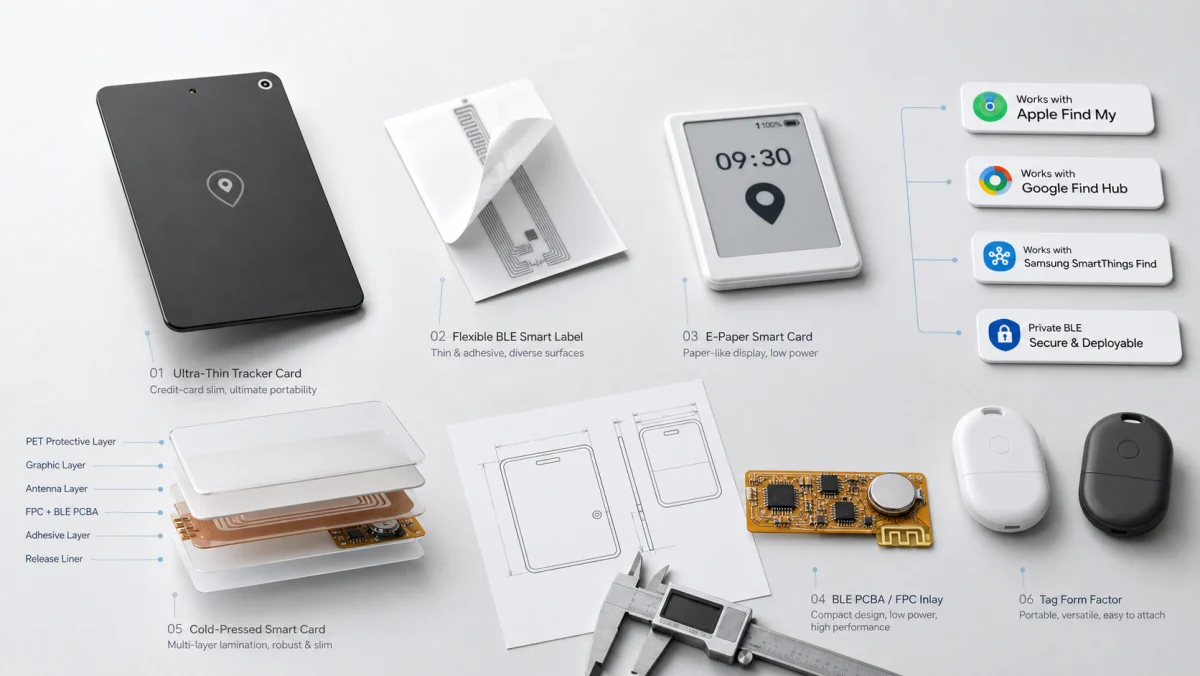
The part of a cold-pressed smart card that is easiest to underestimate is not fitting a PCBA, battery, and antenna inside the outline. It is keeping those parts electrically and mechanically stable after encapsulation, stacking, and forming. Components that passed their own bench tests enter a new stress, dielectric, and acoustic environment inside the finished card. The production test object therefore has to be the complete card, not a collection of separately approved parts.
Why proven parts can still fail as an assembly
Supplier data is normally measured under controlled conditions. Once the materials are combined, their interactions matter: encapsulant changes the antenna environment, differential shrinkage can create bow, the tallest component may take a disproportionate load, and filling the space around an acoustic device changes sound pressure and tone.
Conventional card production is largely concerned with print, layers, dimensions, and surfaces. A cold-pressed electronic card adds battery safety, radio performance, power, buttons, displays, and acoustics to the same manufacturing decision.
Freeze a traceable structural baseline first
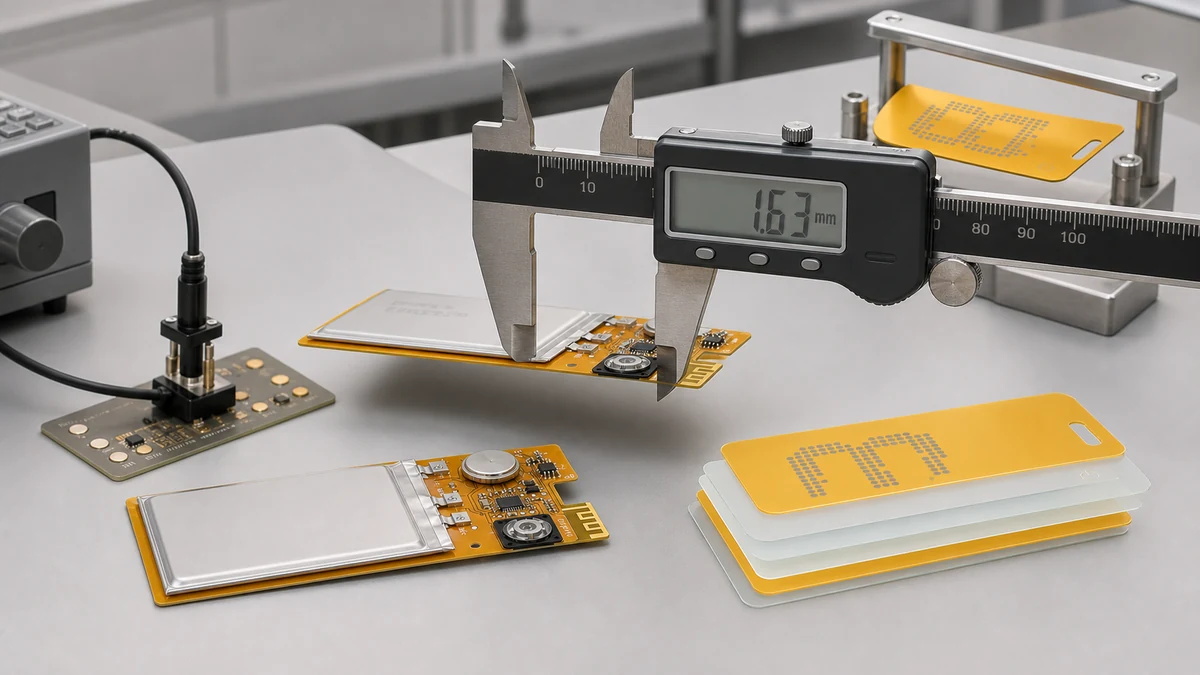
Before joint validation, record the card dimensions, target thickness, face stocks, core, adhesive system, encapsulant, PCBA revision, battery, and maximum component heights. Each pilot build should retain material lots, mix ratio, dispense volume, cure conditions, pressure, dwell time, and tooling state. Without that baseline, a successful sample cannot be reproduced or explained.
Run four groups of checks on the same build
| Group | Typical checks | Decision |
|---|---|---|
| Materials and appearance | Adhesion, voids, overflow, color, surface flatness | Can the material stack form a repeatable card? |
| Dimensions and mechanics | Thickness, bow, bending, drops, button feel | Do the assembly and components survive load? |
| Electronics and radio | Sleep current, BLE/NFC, ringing, battery contact, display refresh | Did forming change performance or power? |
| Environment and life | Temperature, humidity, cycling, aging and retest | Do material differences grow over time? |
Engineering prototypes and pilot builds answer different questions
An engineering prototype asks whether the concept can work: can the parts fit, can thickness be controlled, and is there room to tune the button, sound path, and antenna? A pilot build asks whether the same result can be produced repeatedly with incoming tolerances, work instructions, fixtures, inspection limits, and failure segregation.
Moving directly from a few successful samples to volume production risks treating coincidence as process capability. First articles, in-process samples, failures, and accepted samples should all be retained with their process records.
Production approval depends on distributions, not averages
An acceptable average thickness can hide a local high spot over a component. Normal average current can hide a small population of abnormal wakeups. Production review should look at the limits, spread, and failure modes: where the card is thickest, the direction of bow, acoustic variation, and whether radio weakness correlates with an assembly tolerance.
The design, material stack, and process window are frozen; dimensions and functions have explicit acceptance limits; pilot-build failures are traceable; and the finished product still passes after the agreed environmental and life tests.
Yuli’s role in the program
The customer owns product definition, industrial-design direction, brand, and channel. Yuli can support custom hardware, firmware adaptation, certification preparation, prototypes, pilot builds, and cold-pressed card manufacturing. Joint validation connects structural DFM, material stacking, room-temperature encapsulation, forming, appearance inspection, and functional testing into one traceable production route.